
Hello everyone!
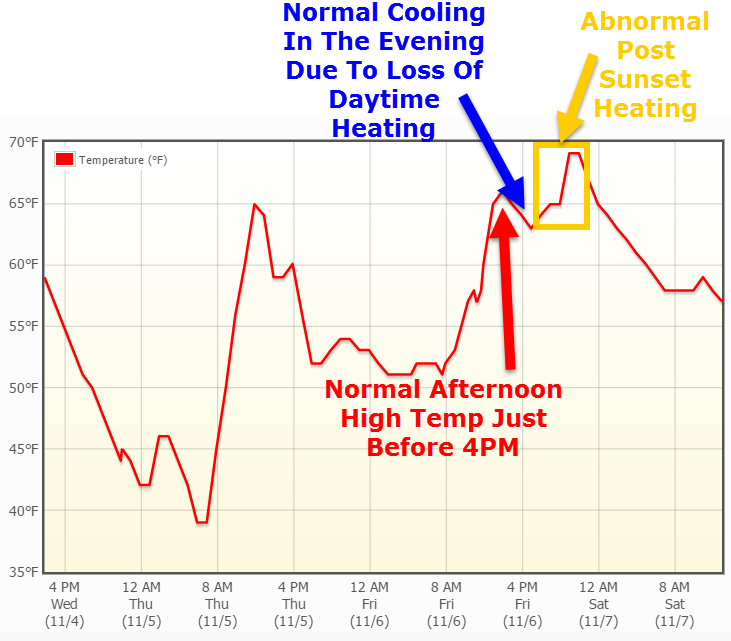
Last night between 8 and 9 PM, something really cool happened all across southern Maine. Several hours after dark and following the passage of a cold front, temps spiked between 4 and 6 degrees in less than an hour going against all logic that temps should fall after dark especially without any large scale weather system to draw warm air north. Let’s see what happened.

At 8:00 last night, a cold front was crossing the area from west to east with SW winds ahead of it and W winds behind it. Temps were already pretty warm, in the 60’s, as southerly winds ahead of the front brought warm air into the region. Colder air lurked behind the front and temps in the 30’s were being reported in the upper Great Lakes with west winds bringing those temps right to us. So what happened? Shouldn’t temps have dropped after the passage of a cold front with an actual cold airmass behind it?
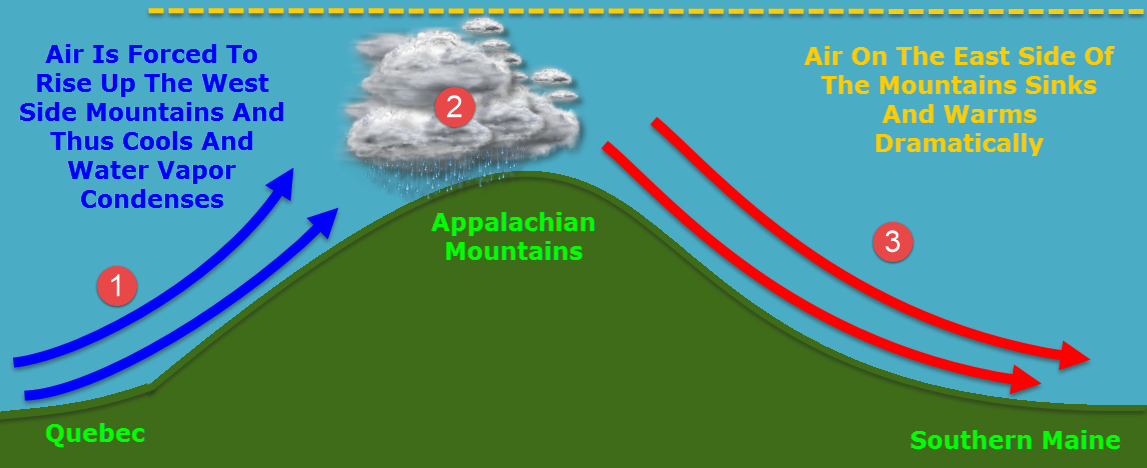
The answer lies in downsloping. This is a term I’ve used a lot but really want to explain here. Winds after the cold front were
westerly/northwesterly and thus the air over southern Maine came from New York/Quebec and then up and over the Appalachian Mountains. When the air rose up the west side of the Appalachians, it cooled but not a lot of the moisture was rung out as shown by the lack of precip at the time.
Because the air was still pretty saturated at the time, the sinking air on the east side of the mountains warmed at the saturated adiabatic lapse rate of roughly 5.5F for every thousand feet. The 5.5 degrees per 1,000 feet figure is for fully saturated air with relative humidity of 100%. The relative humidity in Portland at the time was 73% so the air could be expected to warm at 73% of the moist (partially saturated) adiabatic lapse rate. 73% of 5.5 degrees is 4.015 degrees, very close to the 4 degree rise measured at PWM.
At Augusta, the same calculation works. The temperature rose 5 degrees from 59 degrees at 9 PM to 64 degrees at 11PM. With a relative humidity at 9PM of 90%, that works out to a moist adiabatic lapse rate of 4.95 degrees, again, darn close to the 5 degrees observed in actuality.

Another contributing factor to the suddenness of the spike in temps was warm air aloft suddenly being mixed down to the surface. The 7PM sounding up in Gray showed warm air just above the surface which promptly mixed down with the turbulence caused by the passage of the front.
The air just above the surface was being downsloped to just the right temperature with westerly winds just above the surface and when the surface front came through, the turbulence broke the inversion and sent those warm temps crashing to the ground.
I’ll be back in the morning with tomorrow’s weather. A sneak peek reveals cooler but still not chilly temps in the 50’s with mainly sunny skies.
-Jack
 Forecasterjack
That same deal with the Temp spikes happened a lot back in Tennessee. It was very interesting to me, and I stayed up long nights when it happened, so that I could try to identify any effects (cats acting out of ordinary, silence outside in the forest, etc, etc, etc) But nothing like that happened.. Now, living in Maine, it happens a lot to my cats.