
Hello everyone!
A storm system is moving north out of the Mid Atlantic states this evening and will be tracking towards Cape Cod tonight. A deep plume of tropical moisture is streaming north ahead of this system and its collision with cold air provided by high pressure over Quebec will fuel a messy 24 hours across Maine and New Hampshire. There will be a few paragraphs of the typical technical analysis before the practical forecast part so scroll down if you just want the basics. If you’re interested in learning some of the ‘why behind the what’ of this forecast, read on for some cool meteorology!
Just a quick note that the lateness of this post is due to my crunched schedule this evening and as a result, I wasn’t able to cover in full detail all the awesome stuff going on with this event. For more analysis, check out my updates from Saturday evening and Sunday evening, both of which contain relevant info that still holds more or less true.

The setup for this system is straight out of a synoptic meteorology textbook. A deep upper level low is driving ENE across the Mid Atlantic with deep tropical moisture advecting northward ahead of it. A strong upper level jet streak is aiding in the transfer of low pressure even further ahead of the upper level vorticity enhancing the negative slope of the vorticity column. Meanwhile in the lower levels, Canadian high pressure is advecting cold air southward. The deep warmth aloft and the cold at the surface will result in an icy mess for the region tomorrow.

That cold air at the surface is already causing light snow across York County as cold air traversing warm Gulf of Maine waters produces ocean effect precipitation. These snow showers will slowly drift into the Portland area this evening with a quick coating-1″ possible. The main event begins later this evening. Some dry air will eat away at the leading edge of the precip but by midnight or so, many SW areas will be seeing snow with NW areas following shortly afterward.

Those light ocean effect snow showers will give way to steadier snow tonight as the main event approaches. For coastal and southern sections, snow will quickly transition to sleet while the NW mountains keep the flakes going for longer into the morning. At this point, the rain/mix line will remain well offshore with only the seacoast of NH at risk for raindrops. Most folks SE of the mountains should pick up 1-3″ of snow before the change to sleet occurs during the morning commute. Snow will continue through the morning in the mountains.

The reason that this event will be mainly sleet is that warm air will be present in the mid levels of the atmosphere. As we saw in Saturday night’s update, the cold front that delivered the cold air to the surface/low levels did not make as much progress aloft. The cold front at 10,000 feet is still hung up over Caribou Maine as of 6 PM. Be sure to click that link for an awesome example of an isentropic overrunning surface if you haven’t already!
A quick interlude into thermochemistry is necessary to explain the next part of the forecast: freezing rain. At the bottom of the melting layer, lots of liquid raindrops are freezing into ice pellets. The phase change from liquid to solid is an exothermic process which releases excess energy into the outside environment. This heat energy warms the surrounding air and thus the temperature rises. The opposite happens at the top of the melting layer where endothermic phase changes (melting) takes outside energy from the air and uses it to energize the water molecules. As a result of the net loss in heat energy, the air cools. All this to say that the warm layer will be gradually descending through the event and by the time precip begins to wind down, the warm layer will likely be close enough to the ground to allow for freezing rain.

Here’s what the end result of the above process looks like. Warm air at the surface will likely make it inland across the midcoast east of Bath/Brunswick and along the NH seacoast by this time and may make it to Portland as well though that’s a hard call at the moment. Most folks will be seeing freezing rain at this time with some pockets of snow hanging on in the mountains.

Unlike our last event last week, this one will feature plenty of rapidly rising air as intense divergence aloft combines with low-level convergence along a sharp coastal front. The heavy precip will mainly fall as sleet during the morning commute tomorrow. The intense upward motion may dynamically cool the mid levels enough for some areas to hold onto snow a little longer but unfortunately the influences of the intense SE winds aloft will be too much to overcome. The sight of sleet falling this intensely will be quite interesting as will the sight of up to 3″ of sleet accumulation in the foothills and along the coastal plain. To make things even more fun, we’ll add some wind to the mix.

Winds will be picking up tonight and will peak tomorrow morning during the heavy precip. The heavy precip will act to help transfer very strong winds aloft to the surface right along the coast where the temperature will rise less with height due to warmer surface temperatures minimizing the stabilizing influence of the inversion. Along the midcoast, wind gusts in excess of 50mph are possible. Regardless of the strong inversion inland, the pressure gradient between sub 990mb low pressure and 1025mb+ high pressure will create wind gusts over 30mph at times. For more details on the wind including all the cool vertical profile analysis, check out the updates from the past two days, both Saturday’s and Sunday’s.
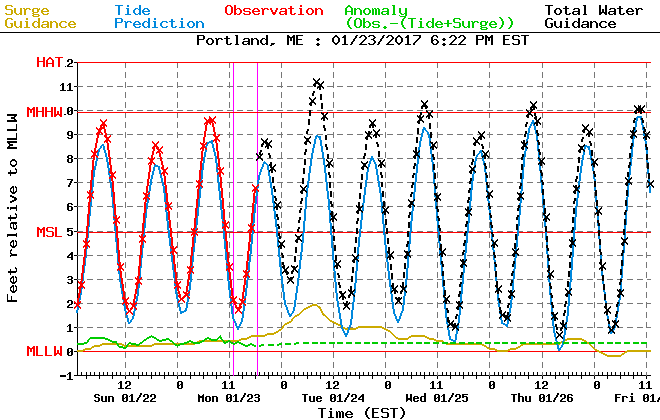
All that wind will generate some wave action and drive a little water towards the coast tomorrow. The high tide to watch will be tomorrow morning around 7 AM when some minor coastal flooding/splashover is expected in typically vulnerable areas. Thankfully tides are astronomically low which means impacts will be minimal/scattered but still worth a mention if your area is especially vulnerable to high water.

Here’s my latest thinking as to total snow/sleet/ice accumulations. The bigger snowfall amounts in excess of 4-5″ will be confined to the far NW mountains where cold air aloft will hold on the longest. Most of the area will see a nasty concoction of snow, sleet, and ice with a thick sludge of slippery stuff coating most surfaces by tomorrow evening. The exception to this will be the midcoast/NH seacoast where rain is expected to mix in.
A total of 1.5-2.5″ of liquid equivalent is likely with this storm so plenty of stuff will fall, it’s just a question of in what form. The forecast is very sensitive to subtle shifts in the mid level temperature profiles and a little more cold air would mean a sizeable snow event especially in the NW while a little warm air could result in an impactful ice storm. Right now, the most likely scenario is for a heavy sleet event but do be aware that could change.
More tomorrow morning.
-Jack
 Forecasterjack