The 5pm advisory from the NHC has come out and there are few differences from at 2. The cone has shifted a few miles north and east. This puts the landfall position in southern New Jersey. This will increase winds and rain by a small amount.
-Jack

The 5pm advisory from the NHC has come out and there are few differences from at 2. The cone has shifted a few miles north and east. This puts the landfall position in southern New Jersey. This will increase winds and rain by a small amount.
-Jack
The Sandy/Nor’ easter hybrid superstorm set to impact the Eastern Seaboard this weekend into early next week has officially been dubbed “Frankenstorm”. I would assume it as a halloween joke but this storm is not joking around. Power outages could top 10 million customers if the underground power plants for NYC are flooded. Even though this sounds far fetched, it is really not. The NHC (National Hurricane Center) has Sandy Moving onshore in Delaware.
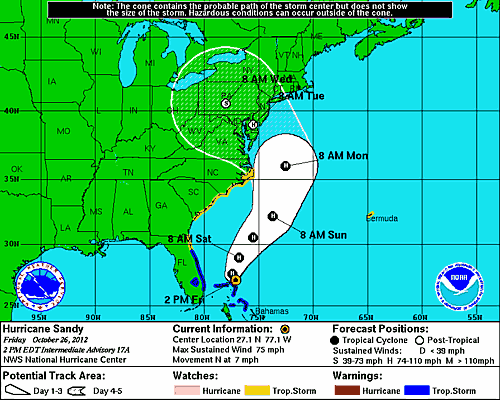
The 2PM track from the hurricane center has Sandy moving onshore in DE as a hurricane.
This would push a 7-11 foot storm tide into NYC. The city has 5 foot flood walls that would easily be overtopped and flooding lower Manhattan and the financial district. The water would rush into the subway system shorting out the electric 3rd rails. Also this surge would rush through the intricate tunnel system making for a huge mess. The power plants are located in these tunnel systems and would be shut down on purpose in anticipation for the storm or, they would get knocked out of service by the surge flooding.
This is supported by few models however and is only there for the European model (ECMWF) which predicts a DC landfall. This is the number one performer among models. There are several less reliable models that like this scenario as well. The second best performer has Sandy making a direct hit on NYC Sunday evening.

The black and purple swath is the Frankenstorm Nor’easter hitting NYC as shown by the American GFS model.
This is a very reasonable scenario for a few reasons. 1) There is a low pressure system located in the Central Atlantic Ocean now and this will act to pull Sandy towards the sea. 2) There is a trough of low pressure moving in from the west as well.
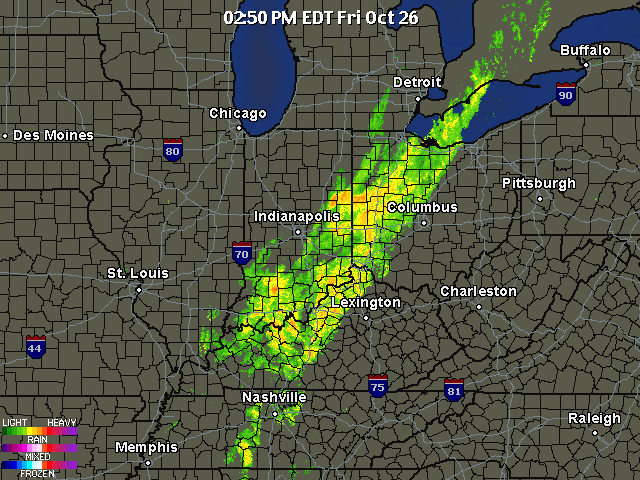
Radar Imagery from 2:50 PM today of the colds front and trough moving in from the west.
This trough will act to pull in Sandy from the SE hitting the NYC area. The max surge would be 15 feet. The trough will also give Sandy a boost of energy which will allow the storm to “bomb out” or undergo cyclogenisis (the rapid deepening or strengthening of a low). The trough will then pull Sandy to the north through western MA and VT.
The cold front and trough will act to create the heaviest October rains ever recorded by taking moisture saturated air and slamming it into cold Canadian air which will mass condense it. The result? Up to 15″of rain for some areas.

The HPC (Hydrometerological Prediction Center) forecast for rainfall. This is in connection with the NHC track so these 15″+ amounts might stretch farther north into NJ and NY. Also, this is only to Wednesday, it will be raining all the way through Thursday for parts of Northern New England.
Speaking of cold air… there will be a snowy side to this system. The storm is very lopsided due to shear, and that will cause the storm to spin energy way to the NW of the center where the cold pocket aloft is. This cold pocket will help to create snow for Pennsylvania and any mountains north of NYC.
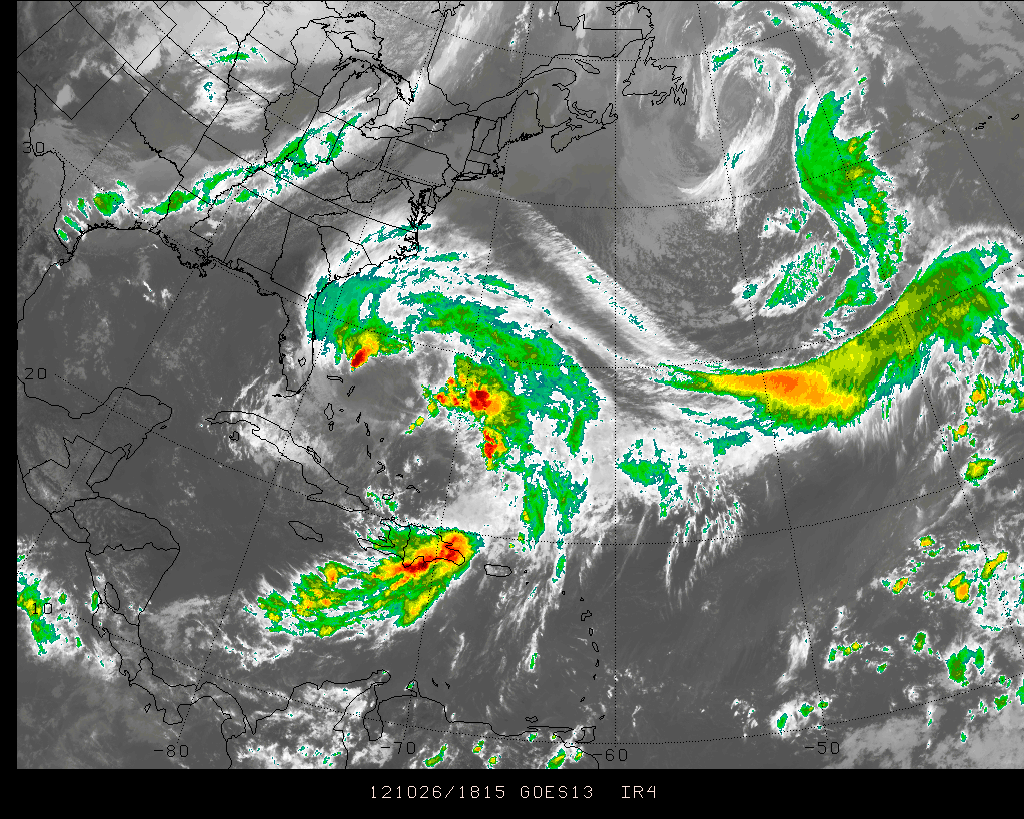
As you can see, there is no hurricane like anything in this inferred satellite image.
Instead is a mass of clouds that stretch all the way from the Caribbean Sea to the Del-Marva Peninsula. The east side has the most activity so even if the storm hits NYC, New England will feel harsh impacts. Although the east side is larger, the storm will grow substantially by the time of landfall and will be able to push activity well to the NW of the center.
-Jack
There is a complex weather situation at play now as Hurricane Sandy moves up the Eastern Seaboard. The latest advisory puts Sandy as a 105mph Hurricane with a lowest pressure is 964mb. Sandy has just moved off the northern coast of Cuba.

Sattellite imagery of Sandy moving off of Cuba.
Now Sandy will continue moving north and then the second factor comes into play. This second factor is a trough of low pressure moving in from the west. This trough will pull in sandy towards the US. Sandy will then “bomb out” off of the NJ coast. Pressures will fall like a rock bottoming out near 949 mb. This is the general consensus of the numerical models. (These are super computers located around the world that take in weather data from around the world. Then this data is fed through a prisim of equations that produce graphs that we weather geeks/ meteorologists then interpert and make forecasts from).
Sandy will then be a Nor’Easter on steroids. This super-noreaster will then move into the coast south or on top of New York City. Surge flooding will be of great concern. There is a 5 foot seawall protecting the financial district from New York Harbor. This storm will be over 2500 miles wide and close to 3500 miles long. This huge storm will generate a 9-12 foot surge on top of the astronomical high tide caused by the full moon on Monday. This would most likely cause flooding in lower Manhattan.
There will be a snowy side to this storm as well. This will be the tropical moisture from Sandy moving up the coast meeting the arctic airmass behind the trough. Pennsylvania and Western New York State as well as the mountains from the Allegheny Mountains in Pennsylvania to the mountains near Mt. Katahdin, Maine could see snow.
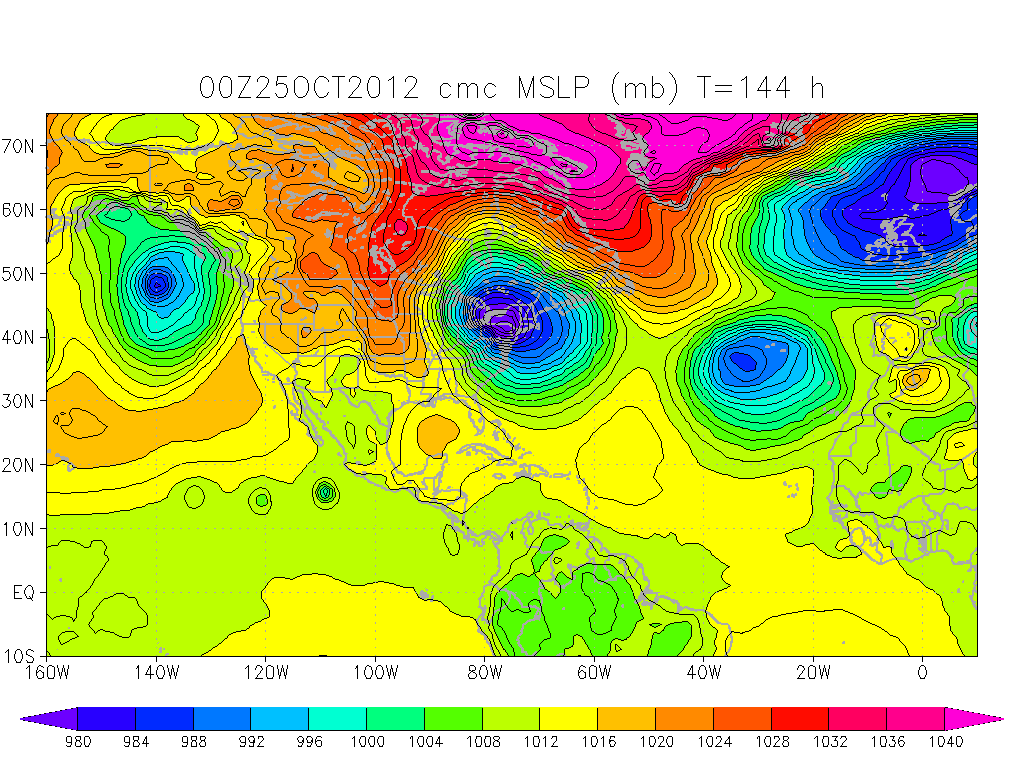
CMC Numerical model plot for Mega Noreaster Sandy.
Snow amounts will be on the order of 4-8″ for lowland Pennsylvania to over 28-36″ on the higher peaks.
Rainfall will also be greatly enhanced by the warm moist air hitting the cold air from Canada causing the heaviest October rains in history. Rainfall amounts could reach over 20″. 12″ is expected over most regions.
Winds will be on the order of potentially 80mph in NYC where the worst of the storm will be. 55-70mph will be widespread with higher gusts. The coast of ME, MA, RI, CT, NY, NJ, and DE will see highest winds peaking around 50-65mph in many places. Exposed areas could get even higher gusts.
Timing will be Saturday-Monday for areas south of VA beach area, Sunday-Tuesday for CT to VA beach area, and Monday-Wednesday for New England.
A developing storm is moving into Ontario this evening spreading rain across the eastern seaboard. A line of severe storm reaches from the Adirondack mountains to Cape Hatters and beyond to the northern Bahamas. Winds will be gusty with 30 mph winds across most areas with winds up to 70 mph in severe thunderstorms. 40-50 mph winds will be common along Cape Cod, Coastal ME and Long Island. 1-5+ inches of rain will be common with highest totals in the Adirondack Mountains.
-JAck
Tomorrow, a powerful cold front will be passing through the eastern 1/3 of the country tomorrow into sunday depending on your location. Severe storms as well as welcome relief from this summers hot temps can be expected. Severe weather will be very promimant especially in NY even the city. Damaging wind and hail can be expected. Tornado threat is moderate for this event. Derechos are likely with this event in PA and NY. Rainfall totals will be in the 1-3″ range.
Stay tuned!
-JAck
Isaac is currently located at 23.9N 81.5W top winds are 60 mph, down slightly and this is likely a sign that Isaac is using its energy to organize its inner core rather than intensifying. The central pressure is 994mb which is down, a sign of intensification. Sometimes before RI (Rapid intensification) the pressure suddenly drops and the winds are steady or weaker only to, 12 hrs later, skyrocket 20, 30 or even 40 mph higher 24 hrs later. This could be what is happening now or it could be dry air that has gotten ingested into the system.

Isaac is moving quite swiftly to the NW at 18mph and will make landfall near New Orleans as a CAT 3. The important thing is though, Isaac is a very large storm with a TS wind field of over 210 miles shown here:

This image shows all areas with TS force winds as of 11 AM this morning. Note how large the orange area is. The area of TS force winds will continue to grow as Isaac intensifies. This map also shows areas under watches and warnings.
Lately Isaac has been firing convection near the center and organizing an eyewall. Long range radar out of Key west shows this quite clearly.

The COC/Eye/LLC (COC=Center of circulation. LLC=Low Level Center) is where the swirl is. You can see that it is nearing Key West and also filling in, a sign of weakening but any weakening will be temporary.
This is the latest Advisory from the NHC :
|
|
|||||||
| 2:00 PM EDT Sun Aug 26 Location: 23.9°N 81.5°W Moving: WNW at 18 mph Min pressure: 994 mb Max sustained: 60 mph |
|||||||
Isaac will strengthen throughout the day with Hurricane force winds expected by tonight. Isaac will then continue to move off the the NW or WNW and may wobble W or N at times. Intensification is expected peaking at a 130 or 135 mph storm if a track across the central GOM pans out. If Isaac moves more NNW or N a weaker storm can be expected. The reason is that OHC (Ocean Heat Content-the fuel for tropical cyclones) is lower in the East GOM than elsewhere because of eddies in the Loop current which is a hot current that runs from the WCAR (West Caribbean) up through the Yucatan Channel and into the GOM before exiting through the FL straits and turning into the Gulf Stream. Every few weeks it sheds a large warm eddy into the Central GOM. these eddies were plentiful during the active 2005 season and caused Katrina and Rita to explosively deepen. A hot eddy like these is in the Central GOM now and a cooler eddy in in the Eastern GOM so if Isaac takes a westerly track , and goes over the hot eddy than a stronger storm (145mph) can be expected. If an easterly track plays out than a weaker storm (110mph) can be expected. New Orleans is also in danger from a 7-9 foot surge and 10+ foot breakers. Model guidance also wants to take the storm into New Orleans

Any track to the West of New Orleans would be much worse putting the city in the right front quad; the most dangerous. Regardless, all interests in the N GOM should be preparing for a major storm.
Stay tuned!
-Jack
TS Isaac is organizing over the FL Keys today and is currently moving WNW or NW with wobbles all over the place. Radar shows a large eye with a CDO (Central Dense Overcast) feature moving over Miami and points south. New models will be running at 12 and at 2 so a full update can be expected then but for now, Models are clustered tightly around New Orleans and have been consistant for around a day now. THERE IS HUGE UNCERTAINTY THOUGH and Isaac could make landfall anywhere from Panama city FL to Port Arthur TX. Isaac will likely hit as a CAT 3 storm with 120 mph winds. a weaker system can be expected if the track is East towards FL and much stronger if a TX track pans out.
Stay tuned, full update by 3:30PM EDT!
TS ISAAC will have the potential to really be a heck of a storm… It is very large and therefore has the potential to be a real mess for a large area. 1st stop: Haiti. As Isaac moves WNW or NW it will likely consolidate into a hurricane. Regardless of wind speeds, Isaac is very moist and capable of dropping heavy rains. Haiti is very susceptible to heavy rains due to deforestation so any rain can cause dangerous mudslides. Adding to the problem over 200,000 people live in makeshift tents/shelters on muddy ground so rain could easily leave many people homeless. Isaac likely will not stop there though. After traversing Hispaniola, likely leading to a humanitarian crisis, he will churn into the Straits of Florida. The water temperatures will be in the 90 degree range. When any tropical entity (TD, TS, or Hurricane) moves over water like this, if shear is low enough, and moisture in plentiful supply then it is a lot like dumping 100 gallons of gasoline on a fire. Sadly for the US, all factors will be in play for RI (rapid intensification) to occur 24 hrs or so after emerging from land. Isaac will then continue WNW or NW into the bathwater of the GOM. RI could continue or resume again here. This is where things get tricky. There is another TS spinning in the C Atl named Joyce. Joyce will move NW for the next 4 to 5 days before causing us meteorologists to argue about what will happen while scratching our heads having no clue what the heck is going on. Here is why; Everything is fine and neat for 4 days. then when day 4 arrives here is the situation: Joyce will be located a few hundred miles south of Bermuda. Isaac will be near Key West. Isaac and Joyce will both get larger and more powerful as time goes on. Monday (day 4) they could interact (meaning 1 storm has an effect on the other).
STAY TUNED!
-JAck
In my roundup of morning model checks, I saw a something that interested me. It was that 2 models predict that a storm, TD9, will impact us. They think that This storm will hit GA then traverse NC and VA then move back out over water and re strengthen before hitting Long Island and moving into the Gulf of ME. This would prove to be a cataclysmic scenario for most of the East coast. Fortunately this is not anticipated but something to watch…
STAY TUNED!!
-JAck
The full version of the tropical update is as follows:
There are several areas of interest now, Gordon, 94L, 95L, a wave off Africa and a wave approaching the Antilles.
Gordon
Initial Winds: 70MPH
Pressure: 987MB
Classification: TS
Gordon will track NE and become extratropicial while moving towards the coast of Spain where showers are likely at most.
94L:
Initial Probability: 80%*
94L will likely continue to move WNW or W. Following in the shadow of another tropical wave 94L is expected to move north of Hispaniola and Cuba. From there, it could make landfall anywhere from Havana Cuba to Halifax Canada. Depending on where it will make landfall, it could hit at a strength of a weak TS or a strong hurricane. THIS STORM IS A THREAT TO THE US!! Stay tuned for future updates!! 94L has a large well defined circulation but lacks heavy thunderstorms to be a classified TD.
95L:
Initial probability: 30%*
95L will likely drift around the NW GOM (Gulf of Mexico) While slowly growing in organization. It could eventually impact the Gulf coast next week.
African Wave:
Initial probability: 20%
This African wave will be moving W while developing at a steady pace. There is high uncertainty with this forecast and THIS STORM COULD ALSO IMPACT THE US IN THE FUTURE!!!
Wave Approaching the Antilles:
Current probability: 0%
The reason I mentioned this Wave is that it is helping 94L develop by leaving a moist environment in its wake. This wave has a small chance of development once it reaches the Western Caribbean.
STAY TUNED!!!
-JAck
 Forecasterjack