Tag Archives: heavy rain

Rain Heavy At Times Tonight

Hello everyone!

Showers are moving in this evening and will continue to do so through the overnight hours. Rain will be heavy at times and steadiest in the northern part of the mountains. The rest of the area will see more scattered heavy rain with thunder and gusty winds possible in the stronger cells. Showers and storms sweep east tomorrow morning with clearing in the afternoon. A few showers are possible Thursday with the passage of a cold front but otherwise the end of the week and the weekend look warm and dry. Another threat for heavy rain arrives early next week with significant heat relief likely following for the rest of next week.

4:30 PM Observations Verifying Today's Forecast. Credit: EDD
4:30 PM Observations Verifying Today’s Forecast. Credit: EDD

Today’s forecast was fairly good. Morning sun slowly faded behind increasing clouds and showers began encroaching from the west this afternoon. Temps stayed mainly in the 70’s as forecast with only a few low 80’s in far southern NH. The showers arrived a hair earlier than forecast and continue to do so this evening but the margin of error there was fairly small. Again, there is no such thing as a perfect forecast but today’s was fairly solid.

4PM Surface Observations Showing The Surface Setup For Tonight. Image Credit: SPC Mesoscale Analysis
4PM Surface Observations Showing The Surface Setup For Tonight. Image Credit: SPC Mesoanalysis

A round of rain ahead of a warm front is moving NE through the area currently. The warm front will lift north before stalling right around Portland tonight. Meanwhile, low pressure will track through the mountains during the same overnight timeframe before pushing a cold front south early tomorrow morning. This is the surface setup and is shown with the 4PM surface analysis map from the SPC mesoanalysis page. The biggest forecast challenge for tonight will be pinpointing exactly where that warm front sets up. North of it, steady heavy rains will put a noticeable dent in the drought. South of it, heavy rains will be hit or miss in a more convective format with some towns getting a much needed drink and others staying more or less completely dry.
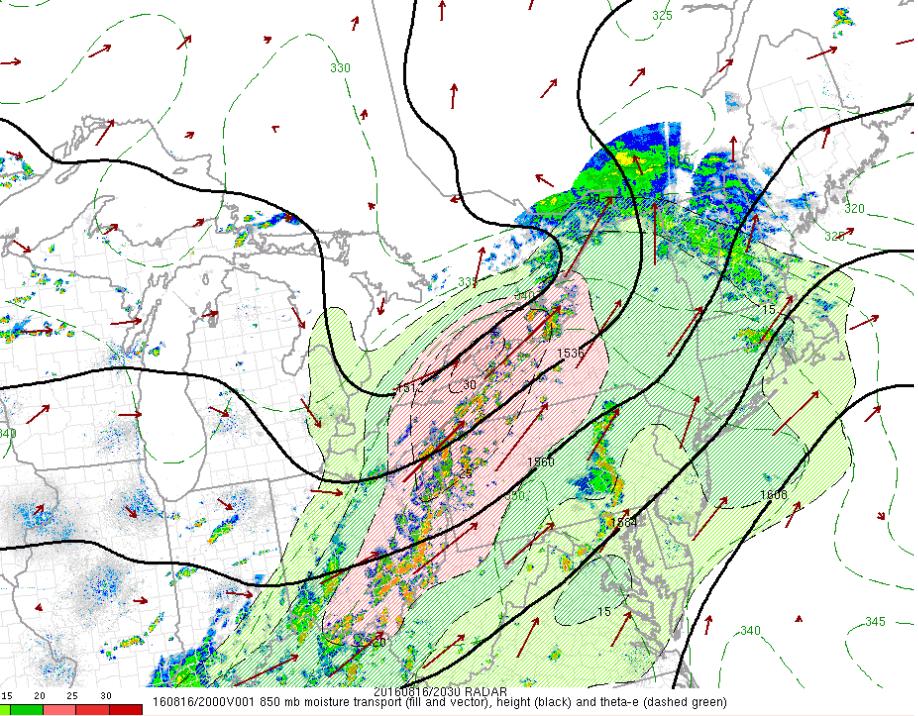
4PM Middle Atmosphere (850mb) Analysis Showing A Plume Of Moisture Headed Our Way. Image Credit: SPC Mesoanalysis
4PM Middle Atmosphere (850mb) Analysis Showing A Plume Of Moisture Headed Our Way. Credit: SPC Mesoanalysis

Aloft, a disturbance over the Eastern Great Lakes will move rapidly NE tonight. SW winds ahead of this disturbance will pump a warm moist airmass into the region. This airmass will feature more Precipitable Water values in excess of 2″ which will support very heavy rain. Pictured is the 850mb moisture field (RH) and vectors showing where that moisture is going (arrows). Notice all the arrows pointing in our direction. This shows that the moisture is headed our way overnight tonight.

HRRR Showing One Idea As To How Things Play Out Tonight. Credit: Weatherbell

So what does this all mean for the forecast tonight into tomorrow morning? The HRRR model does a fairly good job summing it up. Rain will continue to overspread the region from SW to NE this evening and will become heavy at times. The heaviest rain will be concentrated over northern areas with the cutoff somewhere between Portland and Lewiston. North of that cutoff point, steady rain, heavy at times, can be expected with storm totals of 1-2″. Some areas have a shot at seeing up to 3″ if they can manage to sit under a downpour for a while. South of that cutoff, heavy rain will be more scattered with those same 1-2″ amounts falling only where the heaviest downpours track. Those that don’t see individual storms track overhead are likely to miss out on any substantial rain. Most areas in this southern region will see between a tenth and a third of an inch of rain with some spots under the heaviest downpours seeing amounts closer to an inch or two.

Some of the downpours over southern areas could feature thunder and gusty winds as some marginal instability tries to work in aloft. This will not be a widespread severe event but some gusty winds are possible especially across SW NH. The bigger severe threat is to our SW over SNE and NY but we will get some of those storms in a much weakened state. Be aware and have a plan if a warning is issued for your area but otherwise, this won’t be a significant event. Showers and storms sweep NE tomorrow morning with just a few showers left along the coast by sunrise.

12Z GFS Showing A Weak Cold Front Passing Overhead Thursday

The rest of Wednesday will be mostly dry with just an isolated pop up shower here or there. Temps will be warm but not hot and dew points will be sticky but not oppressive. Another cold front will approach the area Thursday which will bring the chance for some more showers and possibly a storm or two. Notice the two low pressure systems back to the west on this map valid Thursday afternoon. Those will slowly work east during the weekend and will end up near us by Monday with a slow moving cold front in tow.

This Morning's Surface Analysis Showing All The Players For This Week's Weather. Image Credit: Meteocentre
This Morning’s Surface Analysis Showing All The Players For This Week’s Weather. Image Credit: Meteocentre

Next week’s rain threat will be centered around Monday. The upper level pattern will shift by then and the seeds of that shift are being sown today. The thick black line is tonight’s disturbance. Thursday’s disturbance is the red line. The lines for the next heavy rainfall threat are the blue one in the top left over NW Canada, the green one south of Bermuda, and the pink one over the Rockies. The blue disturbance will drop south in the coming days and carve out a deep trough. The pink ridge will move offshore by Monday and will end up evolving into a large block off of Nova Scotia. The southerly flow around this block and ahead of the Canadian disturbance will drag tropical moisture provided by the green disturbance northward. There is no reason to change from last night’s forecast anything except the timing. The amplified pattern means that the forward (eastward) progress of each feature will be slowed. Last night, it looked like the heavy rain threat was primarily Sunday into Monday, now guidance indicates it’s more of a Monday/Tuesday affair. Based on the pattern and guidance trends, don’t be surprised if this ends up being more of a middle of next week event. It is still far too early for specifics but if you have plans around this time, keep updated with latest forecasts both from me as well as the NWS and local media.

The deep trough over the Central US that will be providing the focus for this rain threat looks to move east by late next week with more substantial heat relief. How long will that last? It’s anyone’s guess at this point but that should become clearer as we get closer. There is plenty of weather to figure out between now and then.

-Jack

Thunderstorms And Heavy Rain As We Head Into The Weekend

Hello everyone!

We have two interesting weather systems coming our way in the next few days. The first will be a cold front dropping south out of Canada tomorrow afternoon. It will bring with it the threat for showers and storms tomorrow afternoon and into the evening. No severe weather is expected. That front will lose steam and stall somewhere just to our south Friday morning at which point a wave of low pressure will try to develop and move NE along the front. Where that low tracks and how strong it is will determine the outcome of our second weather event and how much beneficial rain we receive. Quieter weather is expected to follow that event with mild temps and sunny skies expected into next week.

Thursday Storms

Screenshot_133
12Z GFS Showing Some Instability Present Tomorrow Afternoon. Image Credit: Weatherbell

Let’s do a quick rundown of the three ingredients needed for strong/severe storms. Doing this will explain why some storms are likely but also why severe storms are not. Instability is a go as temps soar into the 80’s and low 90’s while dew points climb as well, into the upper 60’s to low 70’s. Nothing incredible, but certainly enough for some booms.

12Z NAM And GFS Both Showing Upper Level Energy And A Surface Cold Front To Trigger Storms.

How about a trigger? An upper level disturbance will be pinwheeling around the base of an upper low over Eastern Canada tomorrow. Meanwhile, a surface cold front will be sagging south across the region tomorrow. Both of these are shown in the image above with the left two panels representing one model forecast and the left two representing another. While there are some differences, the general idea remains the same. The general idea is that there will be enough of a trigger to get at least a few storms going. The big question then becomes, will they become organized enough to produce severe weather?

12Z NAM Showing Very Little Shear To Organize Storms. Image Credit: Accuweather

The short answer to that question is no. While guidance indicates some marginal shear, perhaps enough to trigger an isolated severe storm, there is not enough shear to support widespread severe weather. This means that you can expect your typical garden variety thunderstorms tomorrow with heavy rain, frequent lightning, and possibly some gusty winds. Remember, storms don’t have to be severe to be dangerous. Lightning can strike up to 15 miles from a storm and is just as dangerous as strong winds or large hail. When thunder roars, go indoors.

12Z 4kNAM Showing Scattered Storms Tomorrow Afternoon. Image Credit: Weatherbell

Putting that all together, here’s the big picture for tomorrow afternoon/evening. Scattered storms look to develop in the early afternoon over the mountains and will slowly move SE through the afternoon and into the evening hours before reaching the coast in a weakened state later in the evening. Storms are most likely in the mountains and least likely along the coast and especially along the midcoast.

Friday Rain

12Z GFS Showing The Setup Leading To Possible Rain Friday. Image Credit: Weatherbell

Tomorrow’s cold front will stall just off the coast Friday morning and a low pressure area will develop along its southern end over the Mid Atlantic states. The GFS shows this situation well with the map shown depicting conditions at 8:00 Friday morning. Scattered showers are possible during this time but steady rain, if it happens, is likely to occur Friday afternoon/evening. There is still quite a bit of uncertainty in the forecast for Friday as guidance offers several different possibilities. There are two scenarios, the dry scenario, and the wet scenario. I break each down below along with which I think is more likely.

A Comparison Of The 12Z NAM (Right Panels, Wet Solution) And The 12Z GFS (Left Panels, Dry Solution).
A Comparison Of The 12Z NAM (Right Panels, Wet Solution) And The 12Z GFS (Left Panels, Dry Solution). Click To Enlarge.

The NAM and GFS models from this afternoon present the two more extreme solutions: almost no rain on the GFS and tons of rain on the NAM. The map above is data-rich and small, so click it to enlarge it so you can see all the details, if you want. The main difference between the models revolves around the amount of upper level energy in the atmosphere and where that energy is located. The NAM has way more energy (lots of red, top right panel) while the GFS has very little (thin stripe of red, top left panel). Also of note is the location of the kicker disturbance. The software I use to get the data for these graphics makes any boundaries very hard to see so I highlighted New England as well as the Quebec/Ontario border to show the differences in location of the kicker disturbance. Notice that the NAM has it farther west, closer to the border while the GFS has it well east of the border. Keep in mind these maps are valid at the same time. By keeping the kicker farther west, the NAM allows for more moisture to stream northward and also gives the low more time to strengthen, bringing more rain. The GFS on the other hand hurries the kicker along, pushing the storm and the moisture offshore quickly.

12Z NAM (Right) vs 12Z GFS (Left) Both Showing Available Moisture (PWAT)

The difference in moisture can be seen in the Precipitable Water maps which show how much moisture is available. Notice how the blue (super moisture laden air) is much more abundant and closer to the coast on the NAM (right) compared to the GFS (left). Also notice that on both models, SE MA gets in on the action. Heavy rain is likely there but rain chances become more uncertain as you head NW. Notice also how the mountains are in fairly dry air (brown/yellow). Very little rain is expected there. The battleground so to speak will be those areas in between the SE MA coast and the ME/NH mountains.

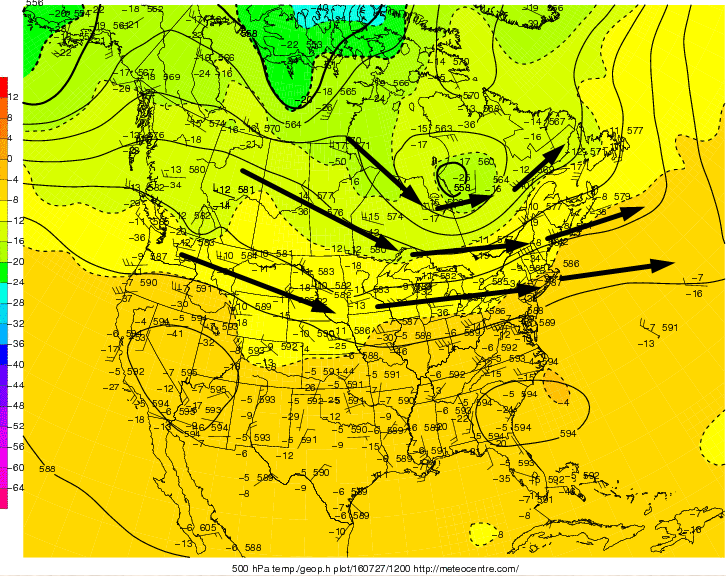
Current (12Z Today) Upper Air (500mb) Analysis. Image Credit: Meteocentre

What do I think will happen? Right now I am leaning towards the GFS’s scenario because the larger scale pattern supports it. This morning’s upper air map shows this well. Winds in the upper atmosphere are overwhelmingly west-east over North America with only shallow ridges and troughs. This “zonal” pattern does not lend itself to troughs digging and amplifying which is what the NAM depicts. Right now, the WNW flow around the heat dome over the SW US looks likely to simply shove the fledgling low off the coast, leaving us with just a few showers or perhaps a brief period of steady rain. SE MA is likely to see the steadiest and heaviest rain with showers making their way all the way up to the base of the mountains. The mountains are likely to stay mostly dry as they are simply too far removed from the deep moisture to our SE. I’ll have more on this tomorrow along with updates on the thunderstorm threat.

Quieter weather is expected through much of next week.

-Jack