
Tag Archives: Hurricane

Tropics heating up…

After an inactive start to the season, we are about to turn over a new page in the tropics. The main driver will be the Madden-Julian Oscillation, a pattern of shifting winds that increases thunderstorm growth that returns to the same area every 30-60 days. This pattern will make itself known later this week into this weekend and will continue through mid September. For those of you who follow tropical weather, we saw this pattern in the Central Pacific and the Eastern Pacific these past few weeks which was why there was so much activity there. (2 storms in a week in the Central Pacific is VERY active) We already have a few interesting African Waves to look at…

IR1

Our 2 African waves that need to be watched. More are expected to arrive from Eastern Africa over the course of the next few weeks.

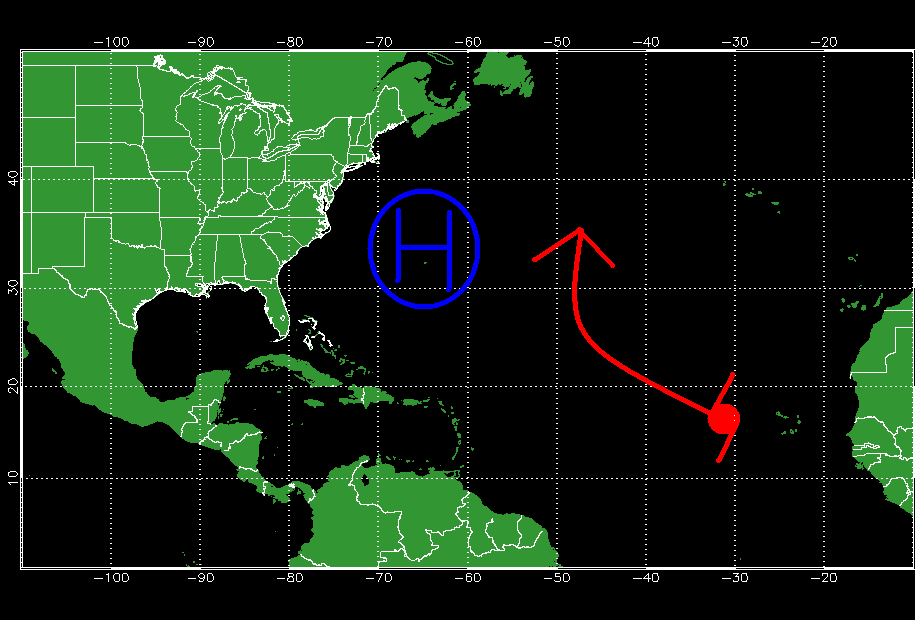
Another unusual thing about this particular MJO pulse if there have only been 2 of this extreme caliber in recent memory. In those 2 cases, 68% or 21 out of 31 depressions formed into hurricanes. The models are already excited showing nearly every wave evolving into a system. Most of which will recurve due to a high pressure system that usually steers it into the Caribbean being too weak to have the westward effect on storms.
ta111

The position of the Bermuda high is further westward and weaker allowing strong storms to recurve easily out to sea.

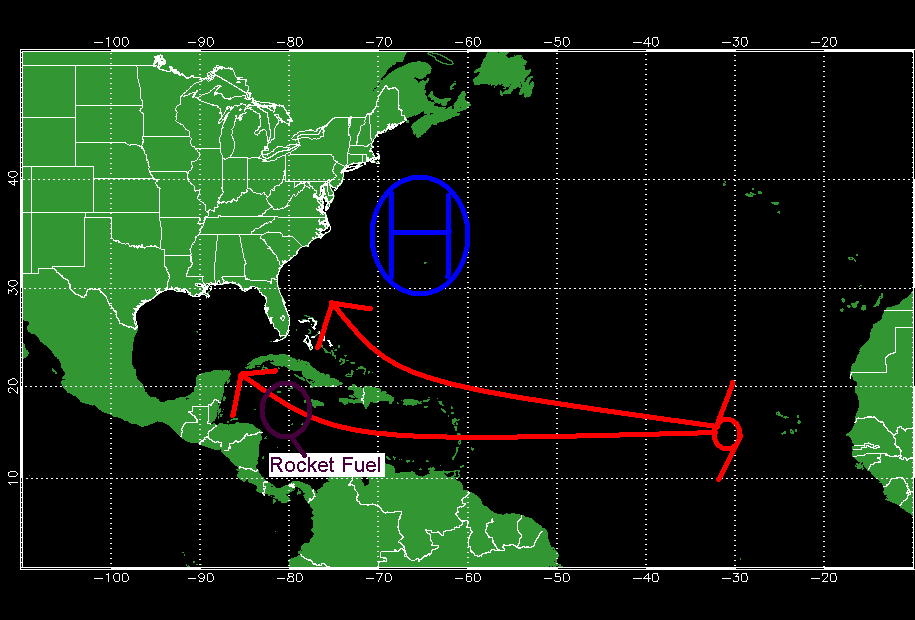
However, if a storm is weak enough it will continue westward into the Caribbean where so called “rocket fuel” is located allowing for rapid intensification under the right circumstances.
ta1111

This map depicts a possible track for a weak storm that can continue westward despite the position of the high.

TCHP1

This map shows where the most possible energy is for a tropical system to feed on.

I believe the last time a storm traversed this area was in 2008, 5 years ago when Gustav moved from the Western Caribbean into Cuba. This is also the same area where Wilma intensified into a monster 882 mb, 180 mph, cat 5 hurricane. The other danger that lies here is that any storm that forms and intensifies WILL affect land and has a 95% chance of making landfall somewhere. The good news is that no model currently forecasts a storm to develop here however its an important area to watch nonetheless.

A further update on the tropics can be expected in a few days or when a system develops or is a threat to develop.

-Jack

2PM advisory/model run update

Isaac is currently located at 23.9N 81.5W  top winds are  60 mph, down slightly and this is likely a sign that Isaac is using its energy to organize its inner core rather than intensifying. The central pressure is 994mb which is down, a sign of intensification. Sometimes before RI (Rapid intensification) the pressure suddenly drops and the winds are steady or weaker only to, 12 hrs later, skyrocket 20, 30 or even 40 mph higher 24 hrs later. This could be what is happening now or it could be dry air that has gotten ingested into the system.

Isaac is moving quite swiftly to the NW at 18mph and will make landfall near New Orleans as a CAT 3. The important thing is though, Isaac is a very large storm with a TS wind field of over 210 miles shown here:

This image shows all areas with TS force winds as of 11 AM this morning. Note how large the orange area is. The area of TS force winds will continue to grow as Isaac intensifies. This map also shows areas under watches and warnings.

Lately Isaac has been firing convection near the center and organizing an eyewall. Long range radar out of Key west shows this quite clearly.

The COC/Eye/LLC (COC=Center of circulation. LLC=Low Level Center) is where the swirl is. You can see that it is nearing Key West and also filling in, a sign of weakening but any weakening will be temporary.

This is the latest Advisory from the NHC :


2:00 PM EDT Sun Aug 26
Location: 23.9°N 81.5°W
Moving: WNW at 18 mph
Min pressure: 994 mb
Max sustained: 60 mph

Isaac will strengthen throughout the day with Hurricane force winds expected by tonight. Isaac will then continue to move off the the NW or WNW and may wobble W or N at times. Intensification is expected peaking at a 130 or 135 mph storm if a track across the central GOM pans out. If Isaac moves more NNW or N a weaker storm can be expected. The reason is that OHC (Ocean Heat Content-the fuel for tropical cyclones) is lower in the East GOM than elsewhere because of eddies in the Loop current which is a hot current that runs from the WCAR (West Caribbean)  up through the Yucatan Channel and into the GOM before exiting through the FL straits and turning into the Gulf Stream. Every few weeks it sheds a large warm eddy into the Central GOM. these eddies were plentiful during the active 2005 season and caused Katrina and Rita to explosively deepen. A hot eddy like these is in the Central GOM now and a cooler eddy in in the Eastern GOM so if Isaac takes a westerly track , and goes over the hot eddy than a stronger storm (145mph) can be expected. If an easterly track plays out than a weaker storm (110mph) can be expected. New Orleans is also in danger from a 7-9 foot surge and 10+ foot breakers. Model guidance also wants to take the storm into New Orleans

Any track to the West of New Orleans would be much worse putting the city in the right front quad; the most dangerous. Regardless, all interests in the N GOM should be preparing for a major storm.

Stay tuned!

-Jack