Tag Archives: Tropical cyclone

Atlantic disturbances upgraded, looking better

Our 2 disturbances in the tropical Atlantic have received invest status last night and this morning which opens up mountains of new information about them. I’ll dig through it and do my best to explain it below.

By the numbers:
2 invests (97L and 96L)
1 TS (KIKO)

2 day probability of formation into TD/5 day probability of formation into a TD

97L- NHC 10/10
ME 20/40

96L- NHC 30/30
ME 10/10

KIKO- 60 mph, 1000mb

More details on all systems below.

TWO 8-31-13 EPAC

Atlantic Tropical weather outlook (TWO)
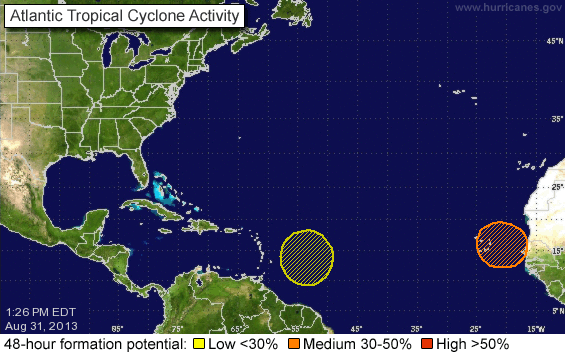
TWO 8-31-13

Eastern Pacific Tropical weather outlook (TWO)

—————————————————————————————————-

I’ll start with the one closest to the Caribbean Islands designated 97L by the NHC this morning.

97L5

Mid afternoon satellite image of 97L.

The forecast for 97L…  Now that this system is an invest, the specially designed hurricane models can weigh in on the forecast. The 2 images below show the intensity forecast and the track forecast from the models.

97L

The intensity forecast from the hurricane models for 97L.

The shaded patches are the different classifications. The bottom white swath is tropical depression status while the middle grey swath is tropical storm status and the uppermost white swath is CAT 1 hurricane status. Read more about tropical cyclone classification here. Read more about hurricane models here.

97L2

This map shows the hurricane models depiction of the storms track.
NOTE: these are just model depictions and are not official forecasts.

Intensity: The models and I are in unanimous agreement that this storm will likely reach tropical storm intensity at some point. Where we differ, is when. I expect the storm to lose a large part of its convection during the diurnal minimum, the time of day where there is the sun’s energy is at its weakest point during the day.Read more about this phenomenon here.

However, DMAX will greet the system bright and early tomorrow morning and will allow for significant return of convection to the system. There is a modest amount of spin associated with this system and with a bit more convection (may happen tomorrow or Labor Day), it could reach TD status. However, there are a few factors suppressing development and one of those is shear.

97L8

This map indicated wind shear in the yellow contours and the upper air wind direction in the tan-ish lines and arrows. Notice the clockwise rotation shown by those arrows over 97L. That is an upper air anticyclone or high pressure. This helps act as a shear force-field and it also shows signs of a healthy upper outflow pattern.

97L6

This graphic shows some of the things that 97L needs to work on. Lets start at the top left. This box indicates an outflow cloud-for lack of better word- which forms when thunderstorms collapse inward and generate a massive burst of wind known as a mirco or macro burst depending on the scale. This sudden release of energy containing cool air from aloft spreads along the surface there warm, moist air resides. The clash of warm and cool creates a cloud.

These clouds signal an unhealthy storm by indicating thunderstorms inside it are dying which decreases its capability to harness the latent heat energy that it depends on. Think of it like a wind turbine suddenly losing its capability to harness the wind energy. Same concept.

The upper right square shows the lack of healthy upper air outflow in 3/4 quadrants of the system. This must also be resolved before it can become a healthy storm. The upper air outflow is a phenomenon that whisks away cool, dry air from the center of the storm to the fringes of the system making more room for warm moist air to take its place.
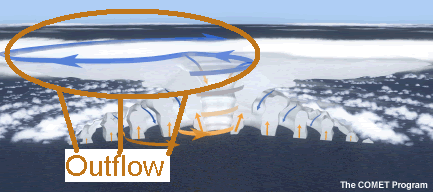
hurricane

Here is a little graphic to show outflow in a hurricane.

The bottom 2 squares are the same thing in different colors. They are microwave imagery that capture the location and intensity of the strongest thunderstorms in a system like this. Notice there are very few bright red dots indicating an absence of strong thunderstorms and therefore, the absence of a functioning storm.

97L7

This graphic shows the 3 main features of 97L. The APPROXIMATE center, the strongest thunderstorms and what outflow channel it has. All 3 areas must improve greatly before TD status can be attained.

Track- This all depends on intensity. As discussed in yesterday’s post, if a storm is strong enough, then it will be more capable of being tugged north by a trough in the upper levels of the atmosphere. This is what will have the most effect on track.

CaribbeanMapLarge (2)

This is where I expect the storm to track through the next few days. However, uncertainties still abound and this map will likely change significantly in tomorrows update. The Northern Windward’s and Leewards should expect heavy rains and high winds from this disturbance.

There is much less to talk about in terms of the Eastern Atlantic disturbance 96L.

96L

This is the early evening satellite image of 96L. I’ve marked the APPROXIMATE center in the black circle and the heaviest thunderstorms inside the red lines. This system is lacking any healthy upper level air pattern and that will be one of its top priorities if it wants to develop into a TD.

96L2

This graphic shows the satellite imagery on the top and the microwave imagery on the bottom. On the bottom, I’ve highlighted the heaviest thunderstorms in black and the center in red. as you can see, it’s a lopsided storm with all the convection to the western side. this is caused by strong upper level winds out of the east. The track and intensity model side is down as I write this do I will not be able to display those graphics at the moment but hopefully it will be back online tomorrow. The forecast from the other models look the same as yesterday, out to sea (OTS) as an open wave. This is the forecast I will stick by as well.

96L3

This map show the shear (highest=red, decreasing to black, the lowest) I highlighted 96L in the red circle and its expected track shown as the red arrow. Also highlighted is the problematic area of high shear outlined in black.

In the tropics elsewhere, we have a tropical storm in the eastern Pacific named Kiko. This storm has top winds of 60 mph. Other information from the NHC is listed below.

2:00 PM PDT Sat Aug 31
Location: 19.3°N 116.2°W
Moving: NNW at 5 mph
Min pressure: 1000 mb
Max sustained: 60 mph

This is the data from the NHC on TS Kiko.

KIKO

This shows Koko’s position in the Eastern Pacific as well as the satellite imagery.  As you can see, shear is also a problem for Kiko as most of its convection is located to the east of the center.

KIKO1

This map shows the satellite imagery on top and the microwave imagery on the bottom. Notice on this microwave imagery, there is a substantial amount of strong thunderstorms signaling a stronger system. Also notice it’s problem with shear- all the convection is pushed to the east signaling strong winds out of the west.

In other weather news…

Invest 96L kills 55 people in Mali from heavy rains. Link
A cold front moving across the eastern US promises a rainy Labor day for the East Coast. Showers/ thunderstorms are possible across the eastern 1/3 of the country Sunday but the real action kicks off Monday with widespread rain and embedded thunderstorms.
Tropical depression Kong-Rey drenched Taiwan causing widespread flooding. Link

I’ll publish another update tomorrow.

-Jack

Disturbances in Atlantic are slowly organizing

There are 2 disturbances in the  tropical Atlantic ocean which have potential to  develop into tropical cyclones. One is located about 700 miles east of the Lesser Antilles and the other over the farthest western reaches of Africa. Lets start with the one that is closer to home.

TWO 8-30-13


This map highlights the NHC‘s OFFICIAL forecast for development. The yellow circle is our first AOI. They gave the wave a 10% chance of development in the next 2 days and a 20% chance in the next 5 days. The orange circle is our 2nd AOI. They give it a 40% chance of development in the next 2 days and a 60% chance of development in the next 5 days.

There is a tropical wave located about 700 miles east of the Lesser Antilles. This wave is moving westward at around 10 mph.

sat3


This shows our first AOI to look at.  The wave will continue to move westward through the Caribbean. When it reaches the Western Caribbean, there is the chance a trough in the upper atmosphere could tug it to the north however, those details are still shady.

GFS1


This is the GFS ensemble upper air map for Saturday. I’ve marked the position of troughs capable of tugging our disturbance northward. Read more about GFS ensembles and this upper air map. The effects of the trough, however will only be felt if the storm sticks up high enough to get caught by the trough. An equally likely scenario (or probably more likely) is that it stays west, crosses Central America, and enters the Eastern Pacific where it could become a tropical cyclone.


shear2


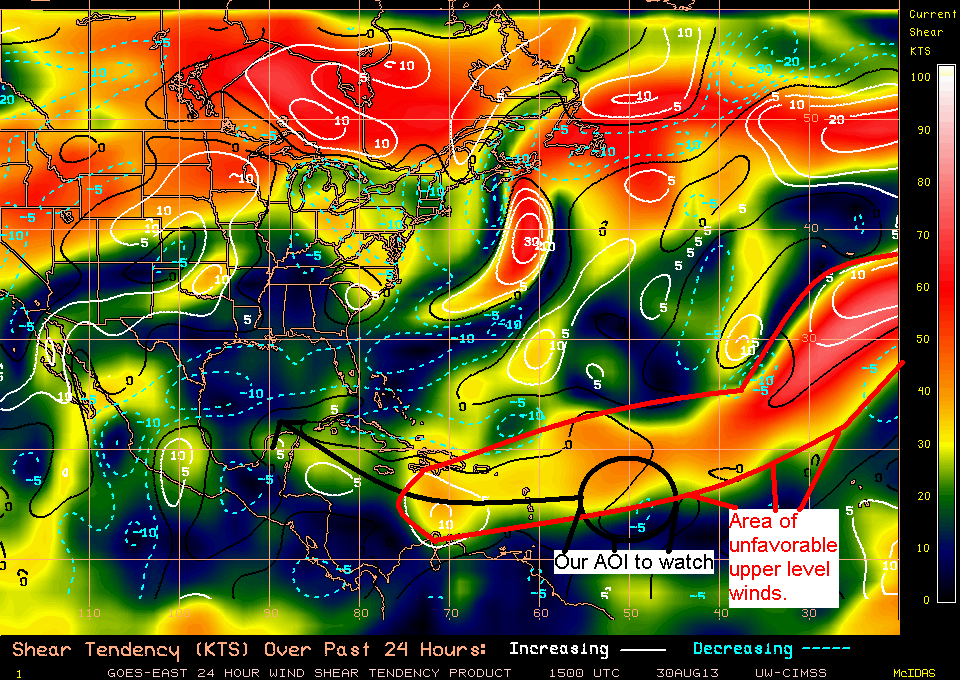
This map shows the main problem for this disturbance-wind shear. This will rip up the thunderstorms which destroys a tropical cyclone. The area of high wind shear is marked with the red line.

The forecast for this disturbance is for little development. I’ll highlight what some of the models think plus my thoughts below.

GFS-Open wave moving west into Central America
NAVGEM-open wave moving NW then re-curving to the NE over open waters.
CMC-The outlier. Has a strong TS/Weak hurricane following a track like Irene through the Bahamas. I doubt this will happen, however it is still a possibility.
My thoughts- I like the GFS’ idea of an open wave tracking over the eastern Caribbean however, I think instead of going into the Eastern Pacific, I think it will track through the Caribbean and over the Yucatan like several other waves have done this season in similar conditions.

CaribbeanMapLarge


This map shows the track I expect it to take along with the impacts I expect it to have on some of the Islands. Areas outlined in light green indicate lighter rain/wind while areas outlined in darker shades of green indicate higher winds and heavier rain. I do not expect any major impacts to be felt anywhere.

Now to our second disturbance. This one shifted its center slightly east over the farthest western tip of Africa. This wave will move NW into the open waters of the North Atlantic. The models don’t really want to do much with it all developing a weak TD or TS at very best.

shear 4

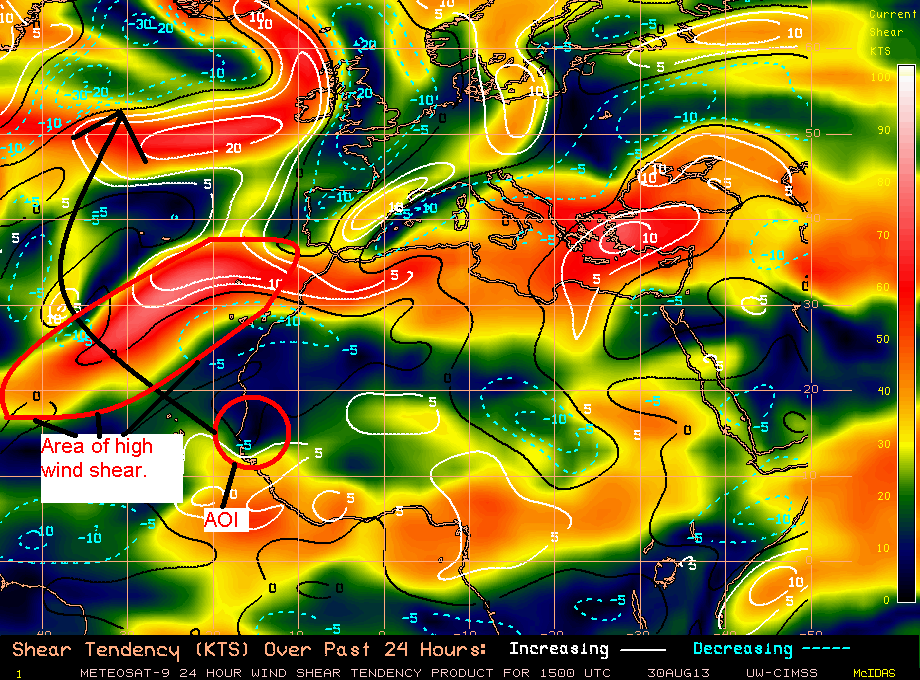
This map shows our AOI and the area of high wind shear it will head into suppressing development. This is the reason that there is little model support for its development.

In other news… There is a strong extra tropical low off the Canadian Maritimes that will give them some rain and wind.

Tropical Depression Kong-Rey in the Western Pacific will bring rain and wind to Japan before swiftly exiting the picture there.

My next post will likely be tomorrow or Sunday.

-Jack


Tropics heating up…

After an inactive start to the season, we are about to turn over a new page in the tropics. The main driver will be the Madden-Julian Oscillation, a pattern of shifting winds that increases thunderstorm growth that returns to the same area every 30-60 days. This pattern will make itself known later this week into this weekend and will continue through mid September. For those of you who follow tropical weather, we saw this pattern in the Central Pacific and the Eastern Pacific these past few weeks which was why there was so much activity there. (2 storms in a week in the Central Pacific is VERY active) We already have a few interesting African Waves to look at…

IR1

Our 2 African waves that need to be watched. More are expected to arrive from Eastern Africa over the course of the next few weeks.

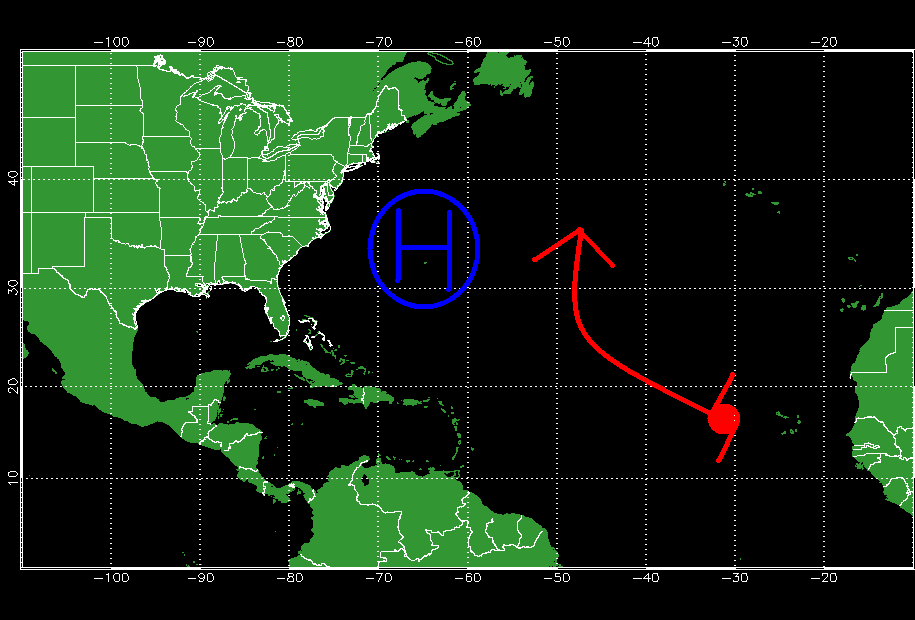
Another unusual thing about this particular MJO pulse if there have only been 2 of this extreme caliber in recent memory. In those 2 cases, 68% or 21 out of 31 depressions formed into hurricanes. The models are already excited showing nearly every wave evolving into a system. Most of which will recurve due to a high pressure system that usually steers it into the Caribbean being too weak to have the westward effect on storms.

ta111

The position of the Bermuda high is further westward and weaker allowing strong storms to recurve easily out to sea.

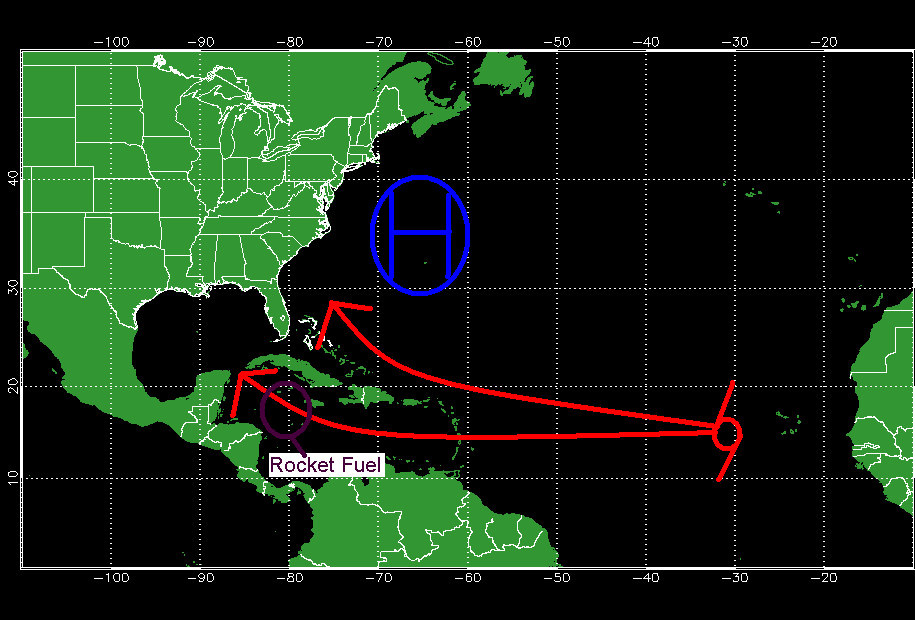
However, if a storm is weak enough it will continue westward into the Caribbean where so called “rocket fuel” is located allowing for rapid intensification under the right circumstances.

ta1111

This map depicts a possible track for a weak storm that can continue westward despite the position of the high.

TCHP1

This map shows where the most possible energy is for a tropical system to feed on.

I believe the last time a storm traversed this area was in 2008, 5 years ago when Gustav moved from the Western Caribbean into Cuba. This is also the same area where Wilma intensified into a monster 882 mb, 180 mph, cat 5 hurricane. The other danger that lies here is that any storm that forms and intensifies WILL affect land and has a 95% chance of making landfall somewhere. The good news is that no model currently forecasts a storm to develop here however its an important area to watch nonetheless.

A further update on the tropics can be expected in a few days or when a system develops or is a threat to develop.

-Jack

8PM-Anylisis of Current Conditions, New Forecsats, and New Intermediate Advisory

Now it is time for the analysis. What exactly is happening? Where is the heaviest rain? Where are the strongest winds? Where is Sandy located? All is answered below.

First, the all-important NHC update.
Winds 75mph
Pressure 950mb
Movement NE 15mph

This has changed only very slightly from at 5 and at 2. The movement has increased slightly and the pressure has loweres a hair to 950 flat. This is down 1 mb from 2PM. This is slight strenghening and we sould expect a more rapid deepening trand as the warm core system moves over the Gulf Stram packing 80 degrees+ SST’s. This will quickly add a core wind speed of 10mph give or take a little and increase to 80-85mph by Monday Morning as it passes.

Sandy has tropical storm force winds extending 1000 miles+ out from the center and hurricane force winds 230 miles+ out from the center. The wierd thing is though, that the tropical storm force winds extend out farther to the NE than SW and the hurricane force winds extend farther to the SW than the NE.

After the Gulf Stream, the system will move over cooler waters of 65-70 degrees and will begin the transition to a full cold core system. This cold core system will be more adept to caputring the baroclinic energy brought in by the trough.

This may seem a bit overwhelming at first but it is just some pretty simple stuff under-cover. The lower left hand box is the moisture in the high levels of the atmosphere (35,000 feet). The moisture from Sandy is clearly visible streaming northward. The dry air that has been pertruding into Sandy’s eastern side is also clearly visible to her S and SE. The main photo is the winds from this altitude. I drew a black line where the approximate jet stream location is. The purple letters are “H” for ridge and “L” for upper level low/trough. Sandy is the ULL off the east coast and the centeral US trough is also shown.

This trough will inject a considerable amout of energy into the system and help to deepen it to a formidible 945mb low or lower just prior to landfall Monday evening. This will easily smash the records of 960, 955mb that have stood for centuries.

The winds between 5000 and 10000 feet will be absolutely howling as Sandy makes landfall as shown by this model plot.

As you can see, there will be winds in excess of 90 knots or 105mph.

This will be cause for major problems due to the convection firing on the western side of this storm will have the oppertunity to mix down down some of these winds to the surface creating quite a problem for the metropolis’. This is done by basically deflecting the winds like a light and a mirror by the downdraft pushing the winds down to the surface. Also, the high rises will be extra suseptable with winds increasing exponentially as you go up so that some of the tippy tops of the NYC sky-scrapers will be experiencing winds of CAT 5 intensity.

Surge is also another big thing to worry about as mentioned before. Surge heights go as following: South of Wilmington <2′, Wilmington to Cape Hatteras 2-6′, Cape Hatteras to VA beach, 3-6′, VA beach to Ocean City 4-7′, Ocean City to Montauk 4-8′, Long Island Sound 6-11′, NYC 11-15’+ Montauk to Boston 3-7′, Boston to Bath 2-5′, and North of Bath <2′

This is from this afternoon showing an 11′ water rise at the battery in Lower Manhattan which would flood out the subways.

Bouys…
NDBC Location: 31.862N 74.835W
Date:Sun, 28 Oct 2012 23:50:00 UTC
Winds: WNW (300°) at 36.9 kt gusting to 44.7 kt
Significant Wave Height: 23.0 ft
Dominant Wave Period: 11 sec
Mean Wave Direction: N (1°)
Atmospheric Pressure: 29.23 in and rising rapidly
Air Temperature: 72.3 F
Water Temperature: 77.4 F

Bouy data from SE of Cape Hatteras is shown above

Station 44065 NDBC Location: 40.369N 73.703W
Date:Sun, 28 Oct 2012 23:50:00 UTC
Winds: NE (40°) at 33.0 kt gusting to 38.9 kt
Significant Wave Height: 13.1 ft
Dominant Wave Period: 13 sec
Mean Wave Direction: SSE (152°)
Atmospheric Pressure: 29.61 in and falling
Air Temperature: 59.0 F
Dew Point: 53.2 F
Water Temperature: 60.6 F

Bouy data from New York Harbor is shown above

Station 44007 NDBC
Location:
43.531N 70.144W
Date:Sun, 28 Oct 2012 23:50:00 UTC
Winds: NNE (20°) at 17.5 kt gusting to 19.4 kt
Significant Wave Height: 4.9 ft
Dominant Wave Period: 8 sec
Atmospheric Pressure: 29.91 in and falling
Air Temperature: 51.3 F
Water Temperature: 53.8 F

Bouy data from just off of Portland ME is shown above

Station 44025 NDBC
Location: 40.250N 73.167W
Date:Sun, 28 Oct 2012 23:50:00 UTC
Winds: NE (40°) at 35.0 kt gusting to 42.7 kt
Significant Wave Height: 16.7 ft
Dominant Wave Period: 9 sec
Mean Wave Direction: ESE (107°)
Atmospheric Pressure: 29.57 in and falling
Air Temperature: 58.6 F
Dew Point: 55.9 F
Water Temperature: 61.3 F

Bouy data from off the Jersey Shore is shown above

Rainfall and inland flooding will be of great concern with rivers in VA already above flood stage prompting warnings. Amounts are as following: 10-12″ for NJ and easten PA as well as MD locally higher. 4-8″ For anywhere North of an Ocean City to Pittsburg line and South of a Pittsburg-NYC line. 1-2″ for areas north of Wilmington to Cleveland all the way over to Bangor Maine.

Satellite image of Sandy in the past few seconds courtesy of GOES 14 SRSOR (super rapid scan operational region)

-Jack


New day, New Forecasts

Today, we are looking at only slight adjustments to the forecast. I now think it will make a direct landfall on NYC. There are a couple reasons that I differ from the NHC track taking it into Southern NJ.


NHC track with landfall in southern NJ.

1) Most of the models have my back. All but the GFDL, and the operational Euro make landfall in NYC.

The CMC, just one of the many many models taking Frankenstorm into NYC.

2) Upper air steering. The steering setup would favor a NYC track due to the position and intensity of the trough. The position of the trough and the ridge from the Canadian Maratimes suggests a landfall from North NJ to Mid-Long Island.

This mornings satellite image showing an active Atlantic basin.

Sandy is clearly seen as the storm off the SE coast. There is a normal extratropical mid latatude low SE of Newfoundland. The area in question is that blob in between the two systems. Will nthis blob continue up the coast with Sandy? Or will it join the extratropical low? This is the big question in my mind because if that band makes it up the coast New England could see major impacts. If not, then it would be up to Sandy and her megastorm to create an east side to her. She has planty of time to do that as she moves up the coast first intensifying as a warm-core system over the Gulf Stream then becoming cold-core over the waters south of NYC and feeding of the trough energy. Either way there would be major impacts.

I think 3-5″ of rain would be likely in New England with amouts possibly reaching 12-15″ over parts of NJ and Southern NY.

Winds will likely peak around 60mph along coastal sections of ME with higher gusts possibly reaching hurricane force. This along with our tropical downpours will be cause for insane power outages. Prepare for anywhere from 2-14 days depending on your priority level (hospitals, cities are high priority, island communities, communities high in the mountains and low priority. Anywhere in between like suburbs or the mid sized town would be mid priority). Winds in NYC will likely be hurricane force with NJ also seeing hurricane force winds. DE, PA, New England, MD, and VA, NC will see tropical storm force winds.

Also, changes this morning, timing. Effects will begin Monday and linger possibly into the end of the workweek. This is because of the effects that I think the mountainous regions of NY will have on slowing the Frankenstorm down. Earlier, it was thought to move over less mountainous terrain and be moved along very quickly by the trough.

-Jack


2PM advisory/model run update

Isaac is currently located at 23.9N 81.5W  top winds are  60 mph, down slightly and this is likely a sign that Isaac is using its energy to organize its inner core rather than intensifying. The central pressure is 994mb which is down, a sign of intensification. Sometimes before RI (Rapid intensification) the pressure suddenly drops and the winds are steady or weaker only to, 12 hrs later, skyrocket 20, 30 or even 40 mph higher 24 hrs later. This could be what is happening now or it could be dry air that has gotten ingested into the system.

Isaac is moving quite swiftly to the NW at 18mph and will make landfall near New Orleans as a CAT 3. The important thing is though, Isaac is a very large storm with a TS wind field of over 210 miles shown here:

This image shows all areas with TS force winds as of 11 AM this morning. Note how large the orange area is. The area of TS force winds will continue to grow as Isaac intensifies. This map also shows areas under watches and warnings.

Lately Isaac has been firing convection near the center and organizing an eyewall. Long range radar out of Key west shows this quite clearly.

The COC/Eye/LLC (COC=Center of circulation. LLC=Low Level Center) is where the swirl is. You can see that it is nearing Key West and also filling in, a sign of weakening but any weakening will be temporary.

This is the latest Advisory from the NHC :


2:00 PM EDT Sun Aug 26
Location: 23.9°N 81.5°W
Moving: WNW at 18 mph
Min pressure: 994 mb
Max sustained: 60 mph

Isaac will strengthen throughout the day with Hurricane force winds expected by tonight. Isaac will then continue to move off the the NW or WNW and may wobble W or N at times. Intensification is expected peaking at a 130 or 135 mph storm if a track across the central GOM pans out. If Isaac moves more NNW or N a weaker storm can be expected. The reason is that OHC (Ocean Heat Content-the fuel for tropical cyclones) is lower in the East GOM than elsewhere because of eddies in the Loop current which is a hot current that runs from the WCAR (West Caribbean)  up through the Yucatan Channel and into the GOM before exiting through the FL straits and turning into the Gulf Stream. Every few weeks it sheds a large warm eddy into the Central GOM. these eddies were plentiful during the active 2005 season and caused Katrina and Rita to explosively deepen. A hot eddy like these is in the Central GOM now and a cooler eddy in in the Eastern GOM so if Isaac takes a westerly track , and goes over the hot eddy than a stronger storm (145mph) can be expected. If an easterly track plays out than a weaker storm (110mph) can be expected. New Orleans is also in danger from a 7-9 foot surge and 10+ foot breakers. Model guidance also wants to take the storm into New Orleans

Any track to the West of New Orleans would be much worse putting the city in the right front quad; the most dangerous. Regardless, all interests in the N GOM should be preparing for a major storm.

Stay tuned!

-Jack

Isaac could ruin the RNC

TS ISAAC will have the potential to really be a heck of a storm… It is very large and therefore has the potential to be a real mess for a large area. 1st stop: Haiti. As Isaac moves WNW or NW it will likely consolidate into a hurricane. Regardless of wind speeds, Isaac is very moist and capable of dropping heavy rains. Haiti is very susceptible to heavy rains due to deforestation so any rain can cause dangerous mudslides. Adding to the problem over 200,000 people live in makeshift tents/shelters on muddy ground so rain could easily leave many people homeless. Isaac likely will not stop there though. After traversing Hispaniola, likely leading to a humanitarian crisis, he will churn into the Straits of Florida. The water temperatures will be in the 90 degree range. When any tropical entity (TD, TS, or Hurricane) moves over water like this, if shear is low enough, and moisture in plentiful supply then it is a lot like dumping 100 gallons of gasoline on a fire. Sadly for the US, all factors will be in play for RI (rapid intensification) to occur 24 hrs or so after emerging from land. Isaac will then continue WNW or NW into the bathwater of the GOM. RI could continue or resume again here. This is where things get tricky. There is another TS spinning in the C Atl named Joyce. Joyce will move NW for the next 4 to 5 days before causing us meteorologists to argue about what will happen while scratching our heads having no clue what the heck is going on. Here is why; Everything is fine and neat for 4 days. then when day 4 arrives here is the situation: Joyce will be located a few hundred miles south of Bermuda. Isaac will be near Key West. Isaac and Joyce will both get larger and more powerful as time goes on. Monday (day 4) they could interact (meaning 1 storm has an effect on the other).

STAY TUNED!

-JAck