Tag Archives: Atlantic Ocean

Atlantic disturbances upgraded, looking better

Our 2 disturbances in the tropical Atlantic have received invest status last night and this morning which opens up mountains of new information about them. I’ll dig through it and do my best to explain it below.

By the numbers:
2 invests (97L and 96L)
1 TS (KIKO)

2 day probability of formation into TD/5 day probability of formation into a TD

97L- NHC 10/10
ME 20/40

96L- NHC 30/30
ME 10/10

KIKO- 60 mph, 1000mb

More details on all systems below.

TWO 8-31-13 EPAC

Atlantic Tropical weather outlook (TWO)
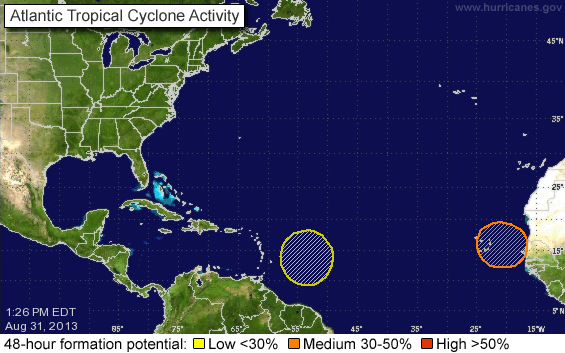
TWO 8-31-13

Eastern Pacific Tropical weather outlook (TWO)

—————————————————————————————————-

I’ll start with the one closest to the Caribbean Islands designated 97L by the NHC this morning.

97L5

Mid afternoon satellite image of 97L.

The forecast for 97L…  Now that this system is an invest, the specially designed hurricane models can weigh in on the forecast. The 2 images below show the intensity forecast and the track forecast from the models.

97L

The intensity forecast from the hurricane models for 97L.

The shaded patches are the different classifications. The bottom white swath is tropical depression status while the middle grey swath is tropical storm status and the uppermost white swath is CAT 1 hurricane status. Read more about tropical cyclone classification here. Read more about hurricane models here.

97L2

This map shows the hurricane models depiction of the storms track.
NOTE: these are just model depictions and are not official forecasts.

Intensity: The models and I are in unanimous agreement that this storm will likely reach tropical storm intensity at some point. Where we differ, is when. I expect the storm to lose a large part of its convection during the diurnal minimum, the time of day where there is the sun’s energy is at its weakest point during the day.Read more about this phenomenon here.

However, DMAX will greet the system bright and early tomorrow morning and will allow for significant return of convection to the system. There is a modest amount of spin associated with this system and with a bit more convection (may happen tomorrow or Labor Day), it could reach TD status. However, there are a few factors suppressing development and one of those is shear.

97L8

This map indicated wind shear in the yellow contours and the upper air wind direction in the tan-ish lines and arrows. Notice the clockwise rotation shown by those arrows over 97L. That is an upper air anticyclone or high pressure. This helps act as a shear force-field and it also shows signs of a healthy upper outflow pattern.

97L6

This graphic shows some of the things that 97L needs to work on. Lets start at the top left. This box indicates an outflow cloud-for lack of better word- which forms when thunderstorms collapse inward and generate a massive burst of wind known as a mirco or macro burst depending on the scale. This sudden release of energy containing cool air from aloft spreads along the surface there warm, moist air resides. The clash of warm and cool creates a cloud.

These clouds signal an unhealthy storm by indicating thunderstorms inside it are dying which decreases its capability to harness the latent heat energy that it depends on. Think of it like a wind turbine suddenly losing its capability to harness the wind energy. Same concept.

The upper right square shows the lack of healthy upper air outflow in 3/4 quadrants of the system. This must also be resolved before it can become a healthy storm. The upper air outflow is a phenomenon that whisks away cool, dry air from the center of the storm to the fringes of the system making more room for warm moist air to take its place.
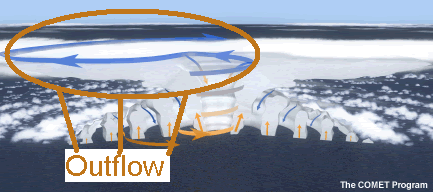
hurricane

Here is a little graphic to show outflow in a hurricane.

The bottom 2 squares are the same thing in different colors. They are microwave imagery that capture the location and intensity of the strongest thunderstorms in a system like this. Notice there are very few bright red dots indicating an absence of strong thunderstorms and therefore, the absence of a functioning storm.

97L7

This graphic shows the 3 main features of 97L. The APPROXIMATE center, the strongest thunderstorms and what outflow channel it has. All 3 areas must improve greatly before TD status can be attained.

Track- This all depends on intensity. As discussed in yesterday’s post, if a storm is strong enough, then it will be more capable of being tugged north by a trough in the upper levels of the atmosphere. This is what will have the most effect on track.

CaribbeanMapLarge (2)

This is where I expect the storm to track through the next few days. However, uncertainties still abound and this map will likely change significantly in tomorrows update. The Northern Windward’s and Leewards should expect heavy rains and high winds from this disturbance.

There is much less to talk about in terms of the Eastern Atlantic disturbance 96L.

96L

This is the early evening satellite image of 96L. I’ve marked the APPROXIMATE center in the black circle and the heaviest thunderstorms inside the red lines. This system is lacking any healthy upper level air pattern and that will be one of its top priorities if it wants to develop into a TD.

96L2

This graphic shows the satellite imagery on the top and the microwave imagery on the bottom. On the bottom, I’ve highlighted the heaviest thunderstorms in black and the center in red. as you can see, it’s a lopsided storm with all the convection to the western side. this is caused by strong upper level winds out of the east. The track and intensity model side is down as I write this do I will not be able to display those graphics at the moment but hopefully it will be back online tomorrow. The forecast from the other models look the same as yesterday, out to sea (OTS) as an open wave. This is the forecast I will stick by as well.

96L3

This map show the shear (highest=red, decreasing to black, the lowest) I highlighted 96L in the red circle and its expected track shown as the red arrow. Also highlighted is the problematic area of high shear outlined in black.

In the tropics elsewhere, we have a tropical storm in the eastern Pacific named Kiko. This storm has top winds of 60 mph. Other information from the NHC is listed below.

2:00 PM PDT Sat Aug 31
Location: 19.3°N 116.2°W
Moving: NNW at 5 mph
Min pressure: 1000 mb
Max sustained: 60 mph

This is the data from the NHC on TS Kiko.

KIKO

This shows Koko’s position in the Eastern Pacific as well as the satellite imagery.  As you can see, shear is also a problem for Kiko as most of its convection is located to the east of the center.

KIKO1

This map shows the satellite imagery on top and the microwave imagery on the bottom. Notice on this microwave imagery, there is a substantial amount of strong thunderstorms signaling a stronger system. Also notice it’s problem with shear- all the convection is pushed to the east signaling strong winds out of the west.

In other weather news…

Invest 96L kills 55 people in Mali from heavy rains. Link
A cold front moving across the eastern US promises a rainy Labor day for the East Coast. Showers/ thunderstorms are possible across the eastern 1/3 of the country Sunday but the real action kicks off Monday with widespread rain and embedded thunderstorms.
Tropical depression Kong-Rey drenched Taiwan causing widespread flooding. Link

I’ll publish another update tomorrow.

-Jack

Disturbances in Atlantic are slowly organizing

There are 2 disturbances in the  tropical Atlantic ocean which have potential to  develop into tropical cyclones. One is located about 700 miles east of the Lesser Antilles and the other over the farthest western reaches of Africa. Lets start with the one that is closer to home.

TWO 8-30-13


This map highlights the NHC‘s OFFICIAL forecast for development. The yellow circle is our first AOI. They gave the wave a 10% chance of development in the next 2 days and a 20% chance in the next 5 days. The orange circle is our 2nd AOI. They give it a 40% chance of development in the next 2 days and a 60% chance of development in the next 5 days.

There is a tropical wave located about 700 miles east of the Lesser Antilles. This wave is moving westward at around 10 mph.

sat3


This shows our first AOI to look at.  The wave will continue to move westward through the Caribbean. When it reaches the Western Caribbean, there is the chance a trough in the upper atmosphere could tug it to the north however, those details are still shady.

GFS1


This is the GFS ensemble upper air map for Saturday. I’ve marked the position of troughs capable of tugging our disturbance northward. Read more about GFS ensembles and this upper air map. The effects of the trough, however will only be felt if the storm sticks up high enough to get caught by the trough. An equally likely scenario (or probably more likely) is that it stays west, crosses Central America, and enters the Eastern Pacific where it could become a tropical cyclone.


shear2


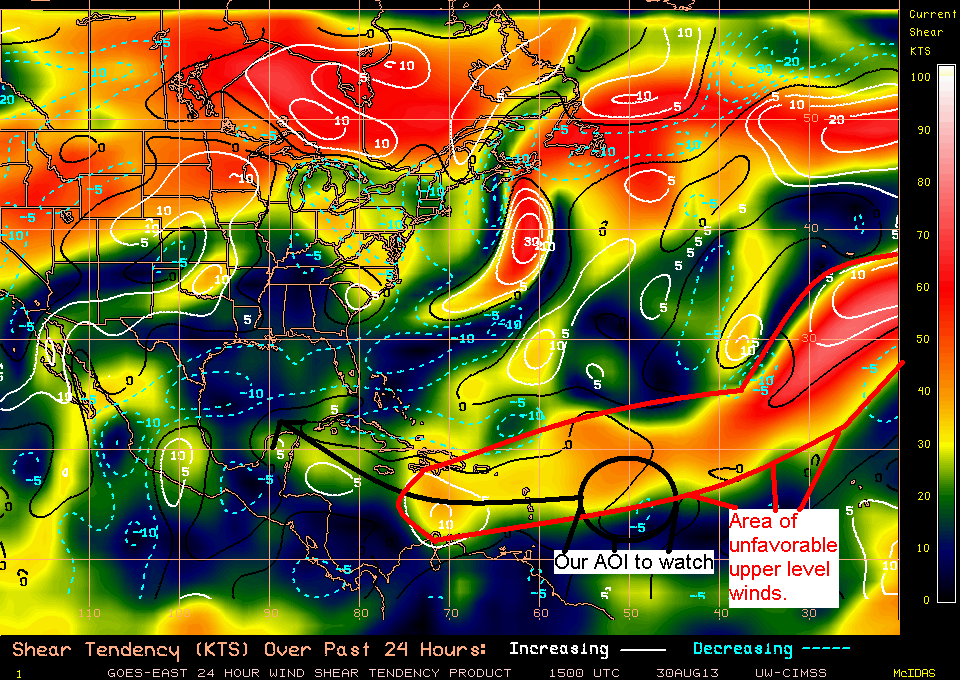
This map shows the main problem for this disturbance-wind shear. This will rip up the thunderstorms which destroys a tropical cyclone. The area of high wind shear is marked with the red line.

The forecast for this disturbance is for little development. I’ll highlight what some of the models think plus my thoughts below.

GFS-Open wave moving west into Central America
NAVGEM-open wave moving NW then re-curving to the NE over open waters.
CMC-The outlier. Has a strong TS/Weak hurricane following a track like Irene through the Bahamas. I doubt this will happen, however it is still a possibility.
My thoughts- I like the GFS’ idea of an open wave tracking over the eastern Caribbean however, I think instead of going into the Eastern Pacific, I think it will track through the Caribbean and over the Yucatan like several other waves have done this season in similar conditions.

CaribbeanMapLarge


This map shows the track I expect it to take along with the impacts I expect it to have on some of the Islands. Areas outlined in light green indicate lighter rain/wind while areas outlined in darker shades of green indicate higher winds and heavier rain. I do not expect any major impacts to be felt anywhere.

Now to our second disturbance. This one shifted its center slightly east over the farthest western tip of Africa. This wave will move NW into the open waters of the North Atlantic. The models don’t really want to do much with it all developing a weak TD or TS at very best.

shear 4

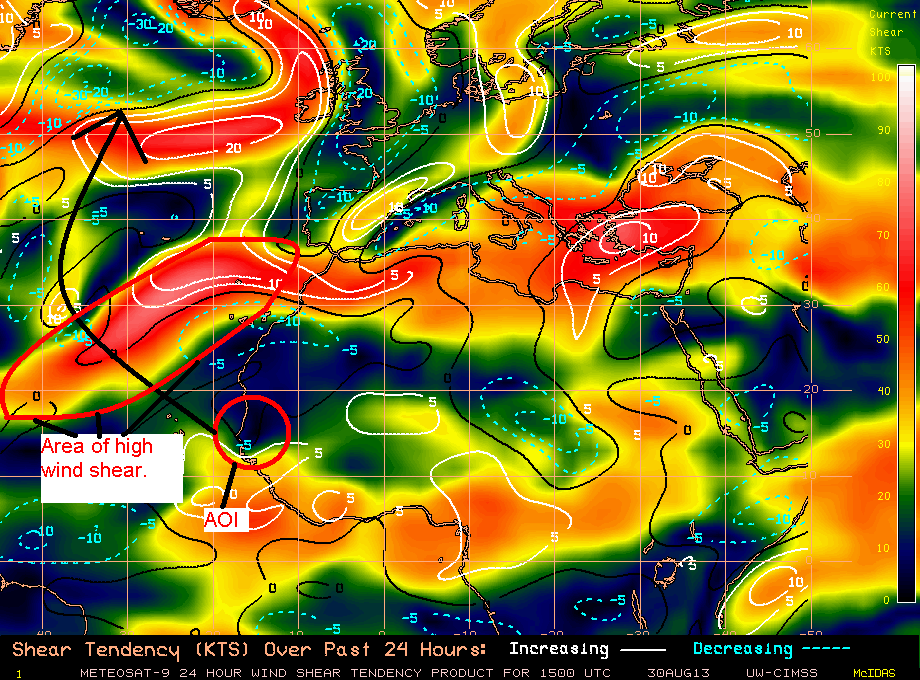
This map shows our AOI and the area of high wind shear it will head into suppressing development. This is the reason that there is little model support for its development.

In other news… There is a strong extra tropical low off the Canadian Maritimes that will give them some rain and wind.

Tropical Depression Kong-Rey in the Western Pacific will bring rain and wind to Japan before swiftly exiting the picture there.

My next post will likely be tomorrow or Sunday.

-Jack


New Models Show Less Impacts in Maine While Mid-Atlantic Sates Get Hit Hard

New models out this morning show Sandy/Frankenstorm making landfall in Centeral NJ Monday evening. This would deliver quite a surge to theNYC area. Surge heights would be on the order of 6-10′. Irene, for example, delivered a 4-5′ surge and missed flooding the subways by mere inches. With 5 extra feet of water and waves already on the order of 8′ in New York Harbor, subway flooding is a real possibility.

Station 44065 NDBC
Location: 40.369N 73.703W
Date:Sun, 28 Oct 2012 10:50:00 UTC

Winds: NNE (30°) at 21.4 kt gusting to 25.3 kt
Significant Wave Height: 8.5 ft
Dominant Wave Period: 12 sec
Mean Wave Direction: SSE (153°)
Atmospheric Pressure: 29.82 in and falling
Air Temperature: 58.3 F
Dew Point: 53.1 F
Water Temperature: 61.9 F
Bouy data from the entrance of New York Harbor.

For those of us who this means nothing to, there are only a few things that are important, 1) Significant Wave Height. This is simple and self-explanitory. How high the waves are above the average water level (excluding tides. Ex: 12 foot waves with a 2 foot surge would be reported as a Sig. Wave Height of 12 not 14). 2) Dominant Wave Period. This shows how powerful the blast of energy creating the wave is. The higher the number in seconds, the more powerful the wave (Ex: a wind blown chop has a 2 second period while a tsunami wave has a 5-8 minute period). 3) The obvious wind and pressure to show the weather in general.

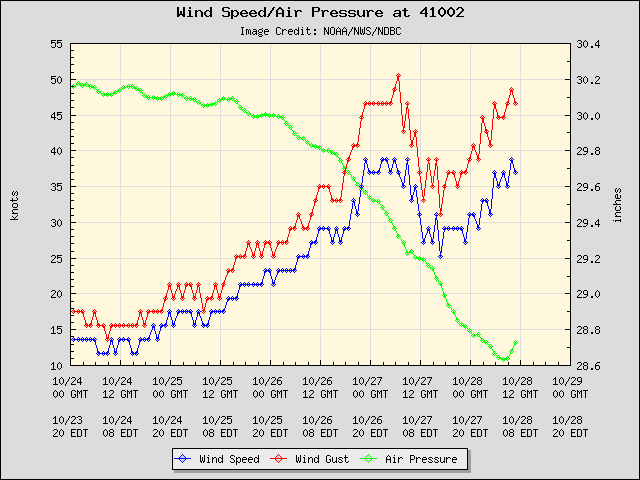
Station 41002 NDBC
Location: 31.862N 74.835W
Date:Sun, 28 Oct 2012 10:50:00 UTC

Winds: NNW (330°) at 36.9 kt gusting to 46.6 kt
Significant Wave Height: 20.0 ft
Dominant Wave Period: 10 sec
Mean Wave Direction: NE (36°)
Atmospheric Pressure: 28.73 in and rising rapidly
Air Temperature: 75.6 F
Water Temperature: 77.7 F

Bouy data from 225 Miles SE of Cape Hatteras.

As you can see by the green Barometric pressure line, the storm center has already pass by though impacts are still severe.

Impacts will be lessened here in Maine due to the storm’s eastern band falling apart. This means that there is not heavy storm on the right hand side of the system. Dont let your gaurd down though…  The storm could easily at any moment decide to build a formidible eastern side or just as easily decide not to. Stay tuned!

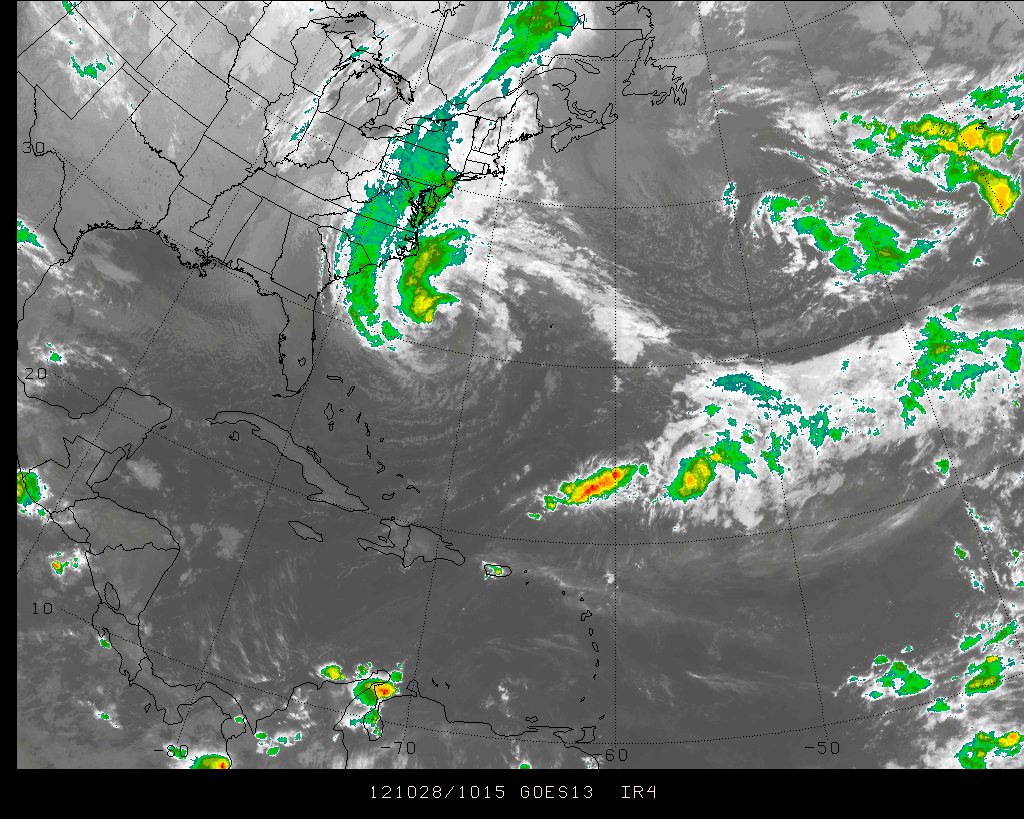
Morning Satellite shot of Frankenstorm. As you can see the eastern half is fairly bleak sparing much of Northern New England

Winds will be in the 30-60ph range peaking Monday. This is for Maine and New Hampshire. 40-65mph for Massachussets. 50-70mph for Rhode Island. 60-80mph for New Jersey where the center of the storm moves in. 70 mph for NYC and Long Island. 50-70mph for much of MD with 45-60mph in far western regions. 35-55mph for Eastern VA with 25-45mph for Western regoins.

Tides will be running 2-4′ above normal due to surge in Maine and 1-3′ above normal due to the full moon. This will cause low-lying areas in Portland to flood. These areas will be along low-lying commercial street and areas adjecent to Back Bay as well as anywhere else that is less than 5-6′ above sea level.

Sandy is currently a Category 1 storm with top winds of 75mph. Below is the full NHC advisory.

…SANDY EXPECTED TO BRING LIFE-THREATENING STORM SURGE FLOODING TO THE MID-ATLANTIC COAST…INCLUDING LONG ISLAND SOUND AND NEW YORK HARBOR… …WINDS EXPECTED TO BE NEAR HURRICANE FORCE AT LANDFALL…


8:00 AM EDT Sun Oct 28
Location: 32.1°N 73.1°W
Moving: NE at 10 mph
Min pressure: 951 mb
Max sustained: 75 mph

This is the data and here is the full write-up. For more info including graphics, go to the nhc home page which can be found at the right of my page.

000
WTNT33 KNHC 281159
TCPAT3

BULLETIN
HURRICANE SANDY INTERMEDIATE ADVISORY NUMBER  24A
NWS NATIONAL HURRICANE CENTER MIAMI FL       AL182012
800 AM EDT SUN OCT 28 2012

…SANDY EXPECTED TO BRING LIFE-THREATENING STORM SURGE FLOODING TO
THE MID-ATLANTIC COAST…INCLUDING LONG ISLAND SOUND AND NEW YORK
HARBOR…
…WINDS EXPECTED TO BE NEAR HURRICANE FORCE AT LANDFALL…

SUMMARY OF 800 AM EDT…1200 UTC…INFORMATION
———————————————-
LOCATION…32.1N 73.1W
ABOUT 260 MI…420 KM SE OF CAPE HATTERAS NORTH CAROLINA
ABOUT 395 MI…635 KM E OF NEW YORK CITY NEW YORK
MAXIMUM SUSTAINED WINDS…75 MPH…120 KM/H
PRESENT MOVEMENT…NE OR 40 DEGREES AT 10 MPH…17 KM/H
MINIMUM CENTRAL PRESSURE…951 MB…28.08 INCHES

WATCHES AND WARNINGS
——————–
CHANGES WITH THIS ADVISORY…

NONE.

SUMMARY OF WATCHES AND WARNINGS IN EFFECT…

A TROPICAL STORM WARNING IS IN EFFECT FOR…
* CAPE FEAR TO DUCK NORTH CAROLINA
* PAMLICO AND ALBEMARLE SOUNDS
* BERMUDA

HIGH WIND WATCHES AND WARNINGS FOR HURRICANE-FORCE WINDS ARE IN
EFFECT FOR PORTIONS OF THE MID-ATLANTIC STATES.  OTHER WATCHES AND
WARNINGS ARE IN EFFECT FOR MUCH OF NEW ENGLAND. SEE STATEMENTS FROM
LOCAL NATIONAL WEATHER SERVICE FORECAST OFFICES.

FOR STORM INFORMATION SPECIFIC TO YOUR AREA IN THE UNITED STATES…
INCLUDING POSSIBLE INLAND WATCHES AND WARNINGS…PLEASE MONITOR
PRODUCTS ISSUED BY YOUR LOCAL NATIONAL WEATHER SERVICE FORECAST
OFFICE. FOR STORM INFORMATION SPECIFIC TO YOUR AREA OUTSIDE THE
UNITED STATES…PLEASE MONITOR PRODUCTS ISSUED BY YOUR NATIONAL
METEOROLOGICAL SERVICE.

DISCUSSION AND 48-HOUR OUTLOOK
——————————
AT 800 AM EDT…1200 UTC…THE CENTER OF HURRICANE SANDY WAS LOCATED
NEAR LATITUDE 32.1 NORTH…LONGITUDE 73.1 WEST. SANDY IS MOVING
TOWARD THE NORTHEAST NEAR 10 MPH…17 KM/H…AND THIS GENERAL
MOTION IS FORECAST TO CONTINUE THROUGH TODAY.  A TURN TOWARD THE
NORTH AND THEN NORTHWEST IS FORECAST ON MONDAY.  ON THE FORECAST
TRACK…THE CENTER OF SANDY WILL MOVE PARALLEL TO THE SOUTHEAST
COAST OF THE UNITED STATES TODAY AND TONIGHT…AND APPROACH THE
COAST OF THE MID-ATLANTIC STATES BY MONDAY NIGHT.

MAXIMUM SUSTAINED WINDS ARE NEAR 75 MPH…120 KM/H…WITH HIGHER
GUSTS.  LITTLE CHANGE IN STRENGTH IS FORECAST DURING THE NEXT
COUPLE OF DAYS…AND SANDY IS EXPECTED TO BRING HURRICANE-FORCE
WINDS TO PORTIONS OF THE MID-ATLANTIC STATES.

HURRICANE-FORCE WINDS EXTEND OUTWARD UP TO 175 MILES…280 KM…FROM
THE CENTER…AND TROPICAL-STORM-FORCE WINDS EXTEND OUTWARD UP TO
520 MILES…835 KM. A SHIP LOCTAED ABOUT 100 MILES SOUTH OF
MOREHEAD CITY NORTH CAROLINA RECENTLY REPORTED SUSTAINED WINDS NEAR
HURRICANE FORCE. ALSO…NOAA BUOY 41036…LOCATED IN ONSLOW BAY
NEAR THE NORTH CAROLINA COAST…RECENTLY REPORTED SUSTAINED WINDS
OF 47 MPH…76 KM/H…AND A WIND GUST OF 59 MPH…94 KM/H.

THE MINIMUM CENTRAL PRESSURE RECENTLY REPORTED BY NOAA AND AIR FORCE
RESERVE HURRICANE HUNTER AIRCRAFT WAS 951 MB…28.08 INCHES.

HAZARDS AFFECTING LAND
———————-
WIND…TROPICAL STORM CONDITIONS ARE SPREADING ACROSS THE COAST OF
NORTH CAROLINA IN THE TROPICAL STORM WARNING AREA…AND THESE
SHOULD CONTINUE THROUGH TODAY.  GALE FORCE WINDS ARE EXPECTED TO
ARRIVE ALONG PORTIONS OF THE MID-ATLANTIC COAST LATER TODAY…AND
REACH LONG ISLAND AND SOUTHERN NEW ENGLAND BY MONDAY MORNING. WINDS
AT OR NEAR HURRICANE FORCE COULD REACH THE MID-ATLANTIC STATES…
INCLUDING LONG ISLAND…BY LATE MONDAY.

STORM SURGE…THE COMBINATION OF AN EXTREMELY DANGEROUS STORM SURGE
AND THE TIDE WILL CAUSE NORMALLY DRY AREAS NEAR THE COAST TO BE
FLOODED BY RISING WATERS. THE WATER COULD REACH THE FOLLOWING
DEPTHS ABOVE GROUND IF THE PEAK SURGE OCCURS AT THE TIME OF HIGH
TIDE…

NC SOUTH OF SURF CITY…1 TO 3 FT
NC NORTH OF SURF CITY INCLUDING PAMLICO/ALBEMARLE SNDS…4 TO 6 FT
SE VA AND DELMARVA INCLUDING LOWER CHESAPEAKE BAY…2 TO 4 FT
UPPER AND MIDDLE CHESAPEAKE BAY…1 TO 2 FT
LONG ISLAND SOUND AND RARITAN BAY INCLUDING NEW YORK HARBOR…6 TO
11 FT
ELSEWHERE FROM OCEAN CITY MD TO THE CT/RI BORDER…4 TO 8 FT
CT/RI BORDER TO THE SOUTH SHORE OF CAPE COD INCLUDING BUZZARDS
BAY…3 TO 5 FT

SURGE-RELATED FLOODING DEPENDS ON THE RELATIVE TIMING OF THE SURGE
AND THE TIDAL CYCLE…AND CAN VARY GREATLY OVER SHORT DISTANCES.
GIVEN THE LARGE WIND FIELD ASSOCIATED WITH SANDY…ELEVATED WATER
LEVELS COULD SPAN MULTIPLE TIDE CYCLES RESULTING IN REPEATED AND
EXTENDED PERIODS OF COASTAL AND BAYSIDE FLOODING.  IN ADDITION…
ELEVATED WATERS COULD OCCUR FAR REMOVED FROM THE CENTER OF SANDY.
FURTHERMORE…THESE CONDITIONS WILL OCCUR REGARDLESS OF WHETHER
SANDY IS A TROPICAL OR POST-TROPICAL CYCLONE.  FOR INFORMATION
SPECIFIC TO YOUR AREA…PLEASE SEE PRODUCTS ISSUED BY YOUR LOCAL
NATIONAL WEATHER SERVICE OFFICE.

RAINFALL…RAINFALL TOTALS OF 3 TO 6 INCHES ARE EXPECTED OVER FAR
NORTHEASTERN NORTH CAROLINA WITH ISOLATED MAXIMUM TOTALS OF 8 INCHES
POSSIBLE.  RAINFALL AMOUNTS OF 4 TO 8 INCHES ARE EXPECTED OVER
PORTIONS OF THE MID-ATLANTIC STATES…INCLUDING THE DELMARVA
PENINSULA…WITH ISOLATED MAXIMUM AMOUNTS OF 12 INCHES POSSIBLE.
RAINFALL AMOUNTS OF 1 TO 3 INCHES WITH ISOLATED MAXIMUM AMOUNTS OF
5 INCHES ARE POSSIBLE FROM THE SOUTHERN TIER OF NEW YORK STATE
NORTHEASTWARD THROUGH NEW ENGLAND.

SURF…DANGEROUS SURF CONDITIONS WILL CONTINUE FROM FLORIDA THROUGH
THE MID-ATLANTIC STATES FOR THE NEXT COUPLE OF DAYS AND SPREAD INTO
THE NORTHEASTERN STATES LATER TODAY.

NEXT ADVISORY
————-
NEXT COMPLETE ADVISORY…1100 AM EDT.

$$
FORECASTER STEWART


Finish preparations for an extended period of time without electricity.

-Jack

New day, New Forecasts

Today, we are looking at only slight adjustments to the forecast. I now think it will make a direct landfall on NYC. There are a couple reasons that I differ from the NHC track taking it into Southern NJ.


NHC track with landfall in southern NJ.

1) Most of the models have my back. All but the GFDL, and the operational Euro make landfall in NYC.

The CMC, just one of the many many models taking Frankenstorm into NYC.

2) Upper air steering. The steering setup would favor a NYC track due to the position and intensity of the trough. The position of the trough and the ridge from the Canadian Maratimes suggests a landfall from North NJ to Mid-Long Island.

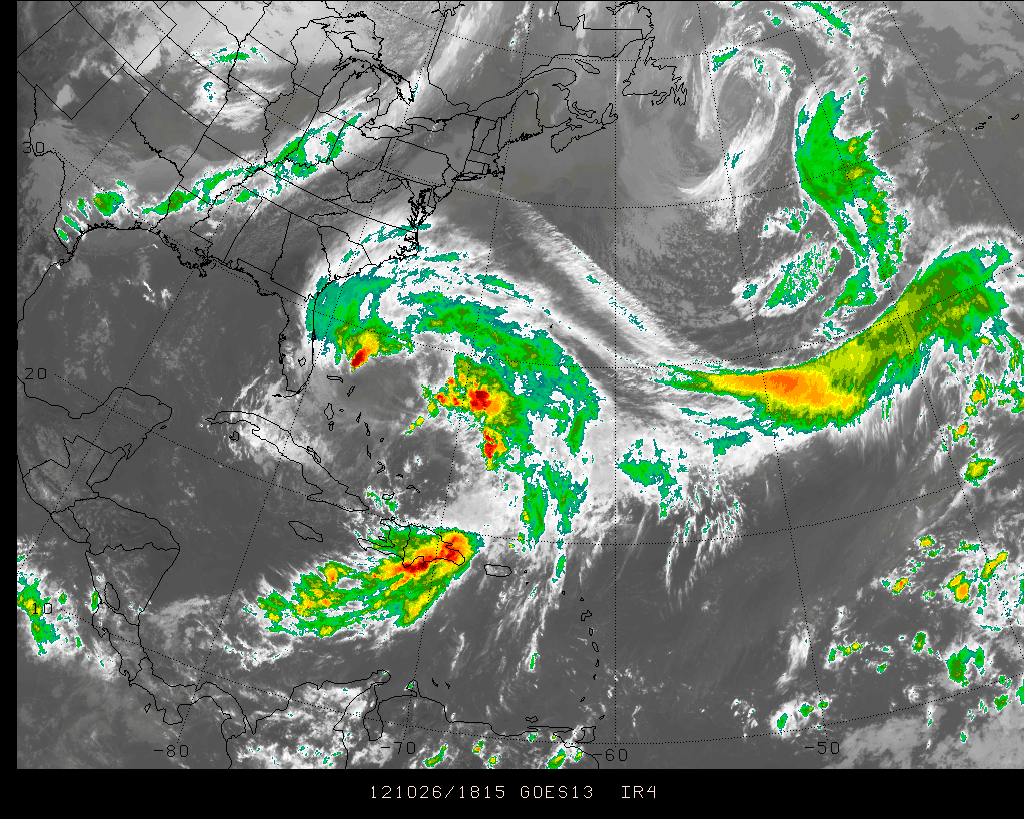
This mornings satellite image showing an active Atlantic basin.

Sandy is clearly seen as the storm off the SE coast. There is a normal extratropical mid latatude low SE of Newfoundland. The area in question is that blob in between the two systems. Will nthis blob continue up the coast with Sandy? Or will it join the extratropical low? This is the big question in my mind because if that band makes it up the coast New England could see major impacts. If not, then it would be up to Sandy and her megastorm to create an east side to her. She has planty of time to do that as she moves up the coast first intensifying as a warm-core system over the Gulf Stream then becoming cold-core over the waters south of NYC and feeding of the trough energy. Either way there would be major impacts.

I think 3-5″ of rain would be likely in New England with amouts possibly reaching 12-15″ over parts of NJ and Southern NY.

Winds will likely peak around 60mph along coastal sections of ME with higher gusts possibly reaching hurricane force. This along with our tropical downpours will be cause for insane power outages. Prepare for anywhere from 2-14 days depending on your priority level (hospitals, cities are high priority, island communities, communities high in the mountains and low priority. Anywhere in between like suburbs or the mid sized town would be mid priority). Winds in NYC will likely be hurricane force with NJ also seeing hurricane force winds. DE, PA, New England, MD, and VA, NC will see tropical storm force winds.

Also, changes this morning, timing. Effects will begin Monday and linger possibly into the end of the workweek. This is because of the effects that I think the mountainous regions of NY will have on slowing the Frankenstorm down. Earlier, it was thought to move over less mountainous terrain and be moved along very quickly by the trough.

-Jack


2 PM Update for “Frankenstorm”

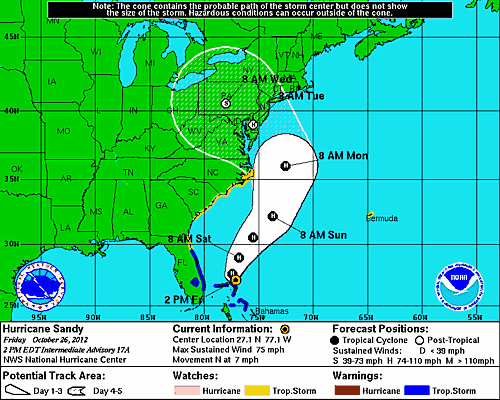
The Sandy/Nor’ easter hybrid superstorm set to impact the Eastern Seaboard this weekend into early next week has officially been dubbed “Frankenstorm”. I would assume it as a halloween joke but this storm is not joking around. Power outages could top 10 million customers if the underground power plants for NYC are flooded. Even though this sounds far fetched, it is really not. The NHC (National Hurricane Center) has Sandy Moving onshore in Delaware.


The 2PM track from the hurricane center has Sandy moving onshore in DE as a hurricane.

This would push a 7-11 foot storm tide into NYC. The city has 5 foot flood walls that would easily be overtopped and flooding lower Manhattan and the financial district. The water would rush into the subway system shorting out the electric 3rd rails. Also this surge would rush through the intricate tunnel system making for a huge mess. The power plants are located in these tunnel systems and would be shut down on purpose in anticipation for the storm or, they would get knocked out of service by the surge flooding.

This is supported by few models however and is only there for the European model (ECMWF) which predicts a DC landfall. This is the number one performer among models. There are several less reliable models that like this scenario as well. The second best performer has Sandy making a direct hit on NYC Sunday evening.

The black and purple swath is the Frankenstorm Nor’easter hitting NYC as shown by the American GFS model.

This is a very reasonable scenario for a few reasons. 1) There is a low pressure system located in the Central Atlantic Ocean now and this will act to pull Sandy towards the sea. 2) There is a trough of low pressure moving in from the west as well.


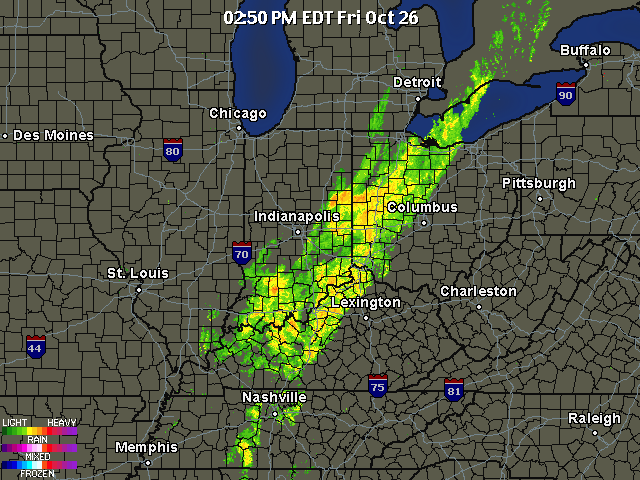
Radar Imagery from 2:50 PM today of the colds front and trough moving in from the west.

This trough will act to pull in Sandy from the SE hitting the NYC area. The max surge would be 15 feet. The trough will also give Sandy a boost of energy which will allow the storm to “bomb out” or undergo cyclogenisis (the rapid deepening or strengthening  of a low). The trough will then pull Sandy to the north through western MA and VT.

The cold front and trough will act to create the heaviest October rains ever recorded by taking moisture saturated air and slamming it into cold Canadian air which will mass condense it. The result? Up to 15″of rain for some areas.


The HPC (Hydrometerological Prediction Center) forecast for rainfall. This is in connection with the NHC track so these 15″+ amounts might stretch farther north into NJ and NY. Also, this is only to Wednesday, it will be raining all the way through Thursday for parts of Northern New England.

Speaking of cold air… there will be a snowy side to this system. The storm is very lopsided due to shear, and that will cause the storm to spin energy way to the NW of the center where the cold pocket aloft is. This cold pocket will help to create snow for Pennsylvania and any mountains north of NYC.

As you can see, there is no hurricane like anything in this inferred satellite image.

Instead is a mass of clouds that stretch all the way from the Caribbean Sea to the Del-Marva Peninsula. The east side has the most activity so even if the storm hits NYC, New England will feel harsh impacts. Although the east side is larger, the storm will grow substantially by the time of landfall and will be able to push activity well to the NW of the center.

-Jack


Climate forecast

Winter 2012-2013:

There will be a weak El Nino and a likely negative PDO. In more simple terms, an area of moderately warm waters off the coast off Peru (El Nino) and Cooler waters off the SW coast of Alaska(Negative PDO). So what does this mean for the US? It means that the eastern seaboard will see cooler temperatures so it will be a cooler than normal winter for the eastern third of the country. Also this set of conditions favors a pattern known as the Greenland block. This is when a ridge of high  pressure sits over Greenland and causes the jet stream (which is a “storm highway” and the divide between warm and cold) to dive south into the Eastern US. This ridging will vary from week to week this winter and will not be as strong as 2010-2011. The East will see Above-average precipitation (likely in the form of snow due to below average temperatures. In the Center of the country there will be the other counterpart to the Eastern trough, the high where the jet stream rises warm air and dry air into the nations heartland causing lower than average snow levels and worsening drought. In the Western US it should be a fairly average winter other than the fact that the Pacific storms will be more powerful and more frequent.

Stay tuned!

-Jack