Tag Archives: East Coast of the United States

Advisory #2 on new Nor’easter

The next storm the east coast will be facing will be a very bad storm for Sandy ravaged areas. This storm will likely bottom out at 990mb slightly weaker then estimates from this morning and a day ago. These estimates suggested pressures of near 980mb. Regardless of pressures, this will be a very bad storm for all ravaged by Sandy. Winds of 35-50mph will ravage areas hit hard by Sandy. Models are trending east with this storm which means that there will be cool air in place in Maine allowing for some snow possibly accumulating to a few inches in mountainous areas. areas closer to the coast may see up to 1″. Accumulations will be tricky to forecast here due to the fact that the ground is warm and it will be a while for the ground to cool off enough to allow for snow to accumulate. 1-2″ of rain will be common from northern NJ to Cape Cod and possibly Seacoast NH.

-Jack

Last update on Sandy as it moves through PA

This is my last analysis of Superstorm Sandy as it is now weakening at a steady clip and although it will continue to affect many along the interior Mid-Atlantic area, it is becoming less and less of a threat. Sandy should be done with us by Thursday and impacts from now on should be much less severe.

Sandy has caused damage in the 10’s of billions of dollars according to Jeff Masters of Weather Underground. This will really not do to much to help the economy and will likely set us back quite a bit. This could most definately affect the presidential election.

Sandy is now weakening over Central PA and will continue to spin north and weaken even more as it moves into Canada. Impacts will be wrapping up and the rainfall should slow down considerably as pressures rise and winds fall. We should be completely done with Sandy by Friday.

From now on, I will expirement with making a graphic every Wednesday evening and posting it here. This might work well or it might not. We will see. My first one will be tomorrow evening. Here is one for tonight.


Afternoon update: storm moving ashore now in NJ, Battery park; other low-lying areas brace for historic flooding

Now this is crunch time. The center of circulation is bearing down on the NJ coast and the winds are picking up here in Maine.

Rain is now moving into the Detroit area now and is continuing steadily in most of the mid-atlantic states.

Forecasts are now holding steady and true (see posts below) and so I will not elaborate too much here.

New update from NHC:
NW movement at 28mph
pressure 940mb
winds 90mph

Hunker down and stay safe!

-JAck

New Models Show Less Impacts in Maine While Mid-Atlantic Sates Get Hit Hard

New models out this morning show Sandy/Frankenstorm making landfall in Centeral NJ Monday evening. This would deliver quite a surge to theNYC area. Surge heights would be on the order of 6-10′. Irene, for example, delivered a 4-5′ surge and missed flooding the subways by mere inches. With 5 extra feet of water and waves already on the order of 8′ in New York Harbor, subway flooding is a real possibility.

Station 44065 NDBC
Location: 40.369N 73.703W
Date:Sun, 28 Oct 2012 10:50:00 UTC

Winds: NNE (30°) at 21.4 kt gusting to 25.3 kt
Significant Wave Height: 8.5 ft
Dominant Wave Period: 12 sec
Mean Wave Direction: SSE (153°)
Atmospheric Pressure: 29.82 in and falling
Air Temperature: 58.3 F
Dew Point: 53.1 F
Water Temperature: 61.9 F
Bouy data from the entrance of New York Harbor.

For those of us who this means nothing to, there are only a few things that are important, 1) Significant Wave Height. This is simple and self-explanitory. How high the waves are above the average water level (excluding tides. Ex: 12 foot waves with a 2 foot surge would be reported as a Sig. Wave Height of 12 not 14). 2) Dominant Wave Period. This shows how powerful the blast of energy creating the wave is. The higher the number in seconds, the more powerful the wave (Ex: a wind blown chop has a 2 second period while a tsunami wave has a 5-8 minute period). 3) The obvious wind and pressure to show the weather in general.

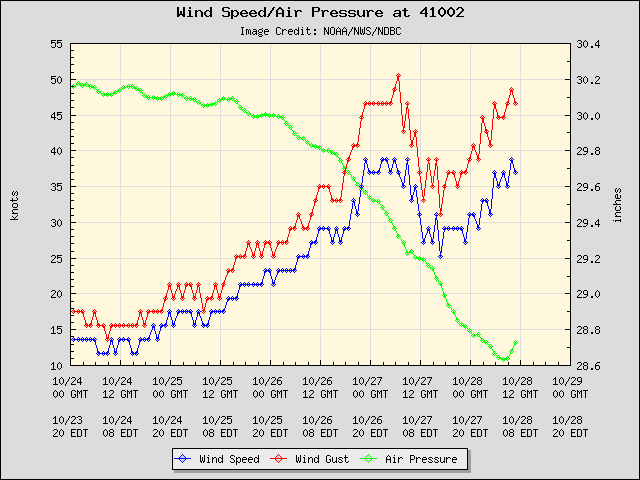
Station 41002 NDBC
Location: 31.862N 74.835W
Date:Sun, 28 Oct 2012 10:50:00 UTC

Winds: NNW (330°) at 36.9 kt gusting to 46.6 kt
Significant Wave Height: 20.0 ft
Dominant Wave Period: 10 sec
Mean Wave Direction: NE (36°)
Atmospheric Pressure: 28.73 in and rising rapidly
Air Temperature: 75.6 F
Water Temperature: 77.7 F

Bouy data from 225 Miles SE of Cape Hatteras.

As you can see by the green Barometric pressure line, the storm center has already pass by though impacts are still severe.

Impacts will be lessened here in Maine due to the storm’s eastern band falling apart. This means that there is not heavy storm on the right hand side of the system. Dont let your gaurd down though…  The storm could easily at any moment decide to build a formidible eastern side or just as easily decide not to. Stay tuned!

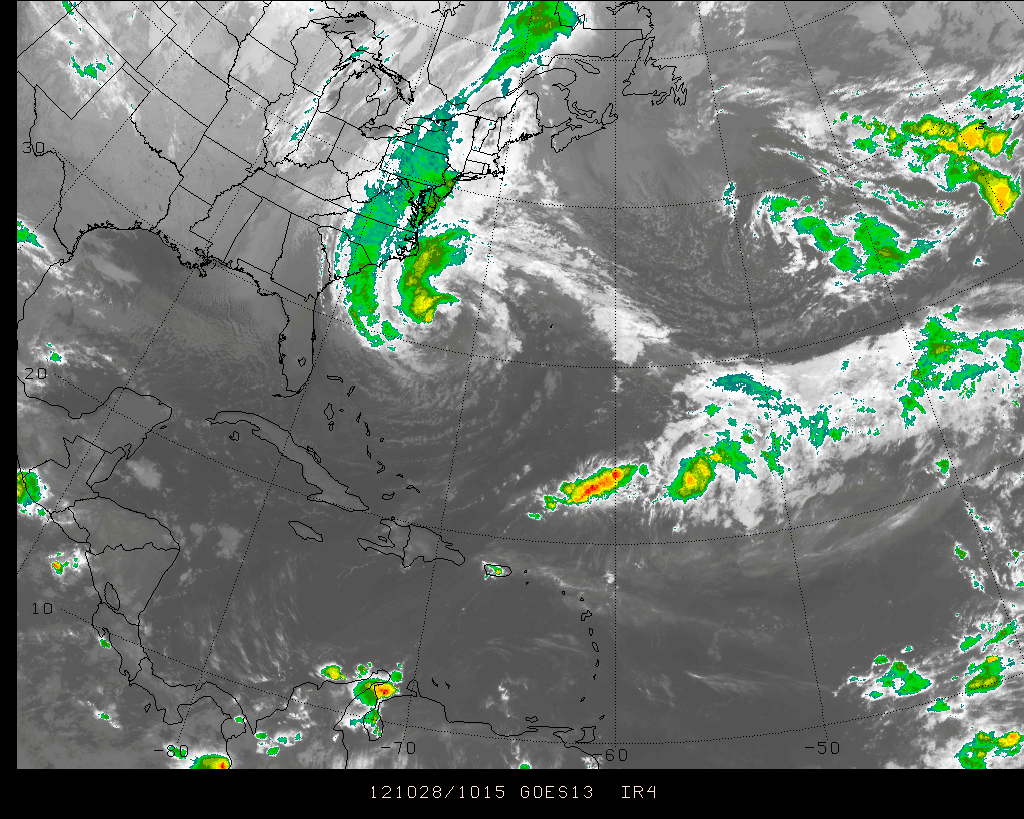
Morning Satellite shot of Frankenstorm. As you can see the eastern half is fairly bleak sparing much of Northern New England

Winds will be in the 30-60ph range peaking Monday. This is for Maine and New Hampshire. 40-65mph for Massachussets. 50-70mph for Rhode Island. 60-80mph for New Jersey where the center of the storm moves in. 70 mph for NYC and Long Island. 50-70mph for much of MD with 45-60mph in far western regions. 35-55mph for Eastern VA with 25-45mph for Western regoins.

Tides will be running 2-4′ above normal due to surge in Maine and 1-3′ above normal due to the full moon. This will cause low-lying areas in Portland to flood. These areas will be along low-lying commercial street and areas adjecent to Back Bay as well as anywhere else that is less than 5-6′ above sea level.

Sandy is currently a Category 1 storm with top winds of 75mph. Below is the full NHC advisory.

…SANDY EXPECTED TO BRING LIFE-THREATENING STORM SURGE FLOODING TO THE MID-ATLANTIC COAST…INCLUDING LONG ISLAND SOUND AND NEW YORK HARBOR… …WINDS EXPECTED TO BE NEAR HURRICANE FORCE AT LANDFALL…


8:00 AM EDT Sun Oct 28
Location: 32.1°N 73.1°W
Moving: NE at 10 mph
Min pressure: 951 mb
Max sustained: 75 mph

This is the data and here is the full write-up. For more info including graphics, go to the nhc home page which can be found at the right of my page.

000
WTNT33 KNHC 281159
TCPAT3

BULLETIN
HURRICANE SANDY INTERMEDIATE ADVISORY NUMBER  24A
NWS NATIONAL HURRICANE CENTER MIAMI FL       AL182012
800 AM EDT SUN OCT 28 2012

…SANDY EXPECTED TO BRING LIFE-THREATENING STORM SURGE FLOODING TO
THE MID-ATLANTIC COAST…INCLUDING LONG ISLAND SOUND AND NEW YORK
HARBOR…
…WINDS EXPECTED TO BE NEAR HURRICANE FORCE AT LANDFALL…

SUMMARY OF 800 AM EDT…1200 UTC…INFORMATION
———————————————-
LOCATION…32.1N 73.1W
ABOUT 260 MI…420 KM SE OF CAPE HATTERAS NORTH CAROLINA
ABOUT 395 MI…635 KM E OF NEW YORK CITY NEW YORK
MAXIMUM SUSTAINED WINDS…75 MPH…120 KM/H
PRESENT MOVEMENT…NE OR 40 DEGREES AT 10 MPH…17 KM/H
MINIMUM CENTRAL PRESSURE…951 MB…28.08 INCHES

WATCHES AND WARNINGS
——————–
CHANGES WITH THIS ADVISORY…

NONE.

SUMMARY OF WATCHES AND WARNINGS IN EFFECT…

A TROPICAL STORM WARNING IS IN EFFECT FOR…
* CAPE FEAR TO DUCK NORTH CAROLINA
* PAMLICO AND ALBEMARLE SOUNDS
* BERMUDA

HIGH WIND WATCHES AND WARNINGS FOR HURRICANE-FORCE WINDS ARE IN
EFFECT FOR PORTIONS OF THE MID-ATLANTIC STATES.  OTHER WATCHES AND
WARNINGS ARE IN EFFECT FOR MUCH OF NEW ENGLAND. SEE STATEMENTS FROM
LOCAL NATIONAL WEATHER SERVICE FORECAST OFFICES.

FOR STORM INFORMATION SPECIFIC TO YOUR AREA IN THE UNITED STATES…
INCLUDING POSSIBLE INLAND WATCHES AND WARNINGS…PLEASE MONITOR
PRODUCTS ISSUED BY YOUR LOCAL NATIONAL WEATHER SERVICE FORECAST
OFFICE. FOR STORM INFORMATION SPECIFIC TO YOUR AREA OUTSIDE THE
UNITED STATES…PLEASE MONITOR PRODUCTS ISSUED BY YOUR NATIONAL
METEOROLOGICAL SERVICE.

DISCUSSION AND 48-HOUR OUTLOOK
——————————
AT 800 AM EDT…1200 UTC…THE CENTER OF HURRICANE SANDY WAS LOCATED
NEAR LATITUDE 32.1 NORTH…LONGITUDE 73.1 WEST. SANDY IS MOVING
TOWARD THE NORTHEAST NEAR 10 MPH…17 KM/H…AND THIS GENERAL
MOTION IS FORECAST TO CONTINUE THROUGH TODAY.  A TURN TOWARD THE
NORTH AND THEN NORTHWEST IS FORECAST ON MONDAY.  ON THE FORECAST
TRACK…THE CENTER OF SANDY WILL MOVE PARALLEL TO THE SOUTHEAST
COAST OF THE UNITED STATES TODAY AND TONIGHT…AND APPROACH THE
COAST OF THE MID-ATLANTIC STATES BY MONDAY NIGHT.

MAXIMUM SUSTAINED WINDS ARE NEAR 75 MPH…120 KM/H…WITH HIGHER
GUSTS.  LITTLE CHANGE IN STRENGTH IS FORECAST DURING THE NEXT
COUPLE OF DAYS…AND SANDY IS EXPECTED TO BRING HURRICANE-FORCE
WINDS TO PORTIONS OF THE MID-ATLANTIC STATES.

HURRICANE-FORCE WINDS EXTEND OUTWARD UP TO 175 MILES…280 KM…FROM
THE CENTER…AND TROPICAL-STORM-FORCE WINDS EXTEND OUTWARD UP TO
520 MILES…835 KM. A SHIP LOCTAED ABOUT 100 MILES SOUTH OF
MOREHEAD CITY NORTH CAROLINA RECENTLY REPORTED SUSTAINED WINDS NEAR
HURRICANE FORCE. ALSO…NOAA BUOY 41036…LOCATED IN ONSLOW BAY
NEAR THE NORTH CAROLINA COAST…RECENTLY REPORTED SUSTAINED WINDS
OF 47 MPH…76 KM/H…AND A WIND GUST OF 59 MPH…94 KM/H.

THE MINIMUM CENTRAL PRESSURE RECENTLY REPORTED BY NOAA AND AIR FORCE
RESERVE HURRICANE HUNTER AIRCRAFT WAS 951 MB…28.08 INCHES.

HAZARDS AFFECTING LAND
———————-
WIND…TROPICAL STORM CONDITIONS ARE SPREADING ACROSS THE COAST OF
NORTH CAROLINA IN THE TROPICAL STORM WARNING AREA…AND THESE
SHOULD CONTINUE THROUGH TODAY.  GALE FORCE WINDS ARE EXPECTED TO
ARRIVE ALONG PORTIONS OF THE MID-ATLANTIC COAST LATER TODAY…AND
REACH LONG ISLAND AND SOUTHERN NEW ENGLAND BY MONDAY MORNING. WINDS
AT OR NEAR HURRICANE FORCE COULD REACH THE MID-ATLANTIC STATES…
INCLUDING LONG ISLAND…BY LATE MONDAY.

STORM SURGE…THE COMBINATION OF AN EXTREMELY DANGEROUS STORM SURGE
AND THE TIDE WILL CAUSE NORMALLY DRY AREAS NEAR THE COAST TO BE
FLOODED BY RISING WATERS. THE WATER COULD REACH THE FOLLOWING
DEPTHS ABOVE GROUND IF THE PEAK SURGE OCCURS AT THE TIME OF HIGH
TIDE…

NC SOUTH OF SURF CITY…1 TO 3 FT
NC NORTH OF SURF CITY INCLUDING PAMLICO/ALBEMARLE SNDS…4 TO 6 FT
SE VA AND DELMARVA INCLUDING LOWER CHESAPEAKE BAY…2 TO 4 FT
UPPER AND MIDDLE CHESAPEAKE BAY…1 TO 2 FT
LONG ISLAND SOUND AND RARITAN BAY INCLUDING NEW YORK HARBOR…6 TO
11 FT
ELSEWHERE FROM OCEAN CITY MD TO THE CT/RI BORDER…4 TO 8 FT
CT/RI BORDER TO THE SOUTH SHORE OF CAPE COD INCLUDING BUZZARDS
BAY…3 TO 5 FT

SURGE-RELATED FLOODING DEPENDS ON THE RELATIVE TIMING OF THE SURGE
AND THE TIDAL CYCLE…AND CAN VARY GREATLY OVER SHORT DISTANCES.
GIVEN THE LARGE WIND FIELD ASSOCIATED WITH SANDY…ELEVATED WATER
LEVELS COULD SPAN MULTIPLE TIDE CYCLES RESULTING IN REPEATED AND
EXTENDED PERIODS OF COASTAL AND BAYSIDE FLOODING.  IN ADDITION…
ELEVATED WATERS COULD OCCUR FAR REMOVED FROM THE CENTER OF SANDY.
FURTHERMORE…THESE CONDITIONS WILL OCCUR REGARDLESS OF WHETHER
SANDY IS A TROPICAL OR POST-TROPICAL CYCLONE.  FOR INFORMATION
SPECIFIC TO YOUR AREA…PLEASE SEE PRODUCTS ISSUED BY YOUR LOCAL
NATIONAL WEATHER SERVICE OFFICE.

RAINFALL…RAINFALL TOTALS OF 3 TO 6 INCHES ARE EXPECTED OVER FAR
NORTHEASTERN NORTH CAROLINA WITH ISOLATED MAXIMUM TOTALS OF 8 INCHES
POSSIBLE.  RAINFALL AMOUNTS OF 4 TO 8 INCHES ARE EXPECTED OVER
PORTIONS OF THE MID-ATLANTIC STATES…INCLUDING THE DELMARVA
PENINSULA…WITH ISOLATED MAXIMUM AMOUNTS OF 12 INCHES POSSIBLE.
RAINFALL AMOUNTS OF 1 TO 3 INCHES WITH ISOLATED MAXIMUM AMOUNTS OF
5 INCHES ARE POSSIBLE FROM THE SOUTHERN TIER OF NEW YORK STATE
NORTHEASTWARD THROUGH NEW ENGLAND.

SURF…DANGEROUS SURF CONDITIONS WILL CONTINUE FROM FLORIDA THROUGH
THE MID-ATLANTIC STATES FOR THE NEXT COUPLE OF DAYS AND SPREAD INTO
THE NORTHEASTERN STATES LATER TODAY.

NEXT ADVISORY
————-
NEXT COMPLETE ADVISORY…1100 AM EDT.

$$
FORECASTER STEWART


Finish preparations for an extended period of time without electricity.

-Jack

2 PM Update for “Frankenstorm”

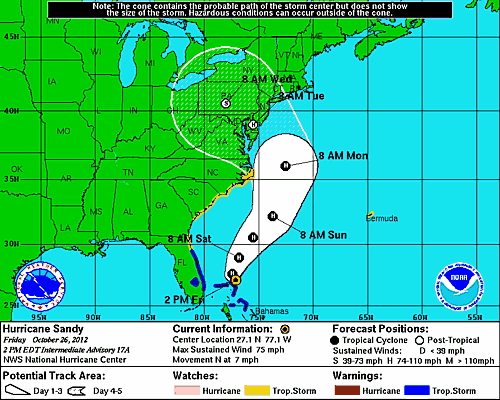
The Sandy/Nor’ easter hybrid superstorm set to impact the Eastern Seaboard this weekend into early next week has officially been dubbed “Frankenstorm”. I would assume it as a halloween joke but this storm is not joking around. Power outages could top 10 million customers if the underground power plants for NYC are flooded. Even though this sounds far fetched, it is really not. The NHC (National Hurricane Center) has Sandy Moving onshore in Delaware.


The 2PM track from the hurricane center has Sandy moving onshore in DE as a hurricane.

This would push a 7-11 foot storm tide into NYC. The city has 5 foot flood walls that would easily be overtopped and flooding lower Manhattan and the financial district. The water would rush into the subway system shorting out the electric 3rd rails. Also this surge would rush through the intricate tunnel system making for a huge mess. The power plants are located in these tunnel systems and would be shut down on purpose in anticipation for the storm or, they would get knocked out of service by the surge flooding.

This is supported by few models however and is only there for the European model (ECMWF) which predicts a DC landfall. This is the number one performer among models. There are several less reliable models that like this scenario as well. The second best performer has Sandy making a direct hit on NYC Sunday evening.

The black and purple swath is the Frankenstorm Nor’easter hitting NYC as shown by the American GFS model.

This is a very reasonable scenario for a few reasons. 1) There is a low pressure system located in the Central Atlantic Ocean now and this will act to pull Sandy towards the sea. 2) There is a trough of low pressure moving in from the west as well.


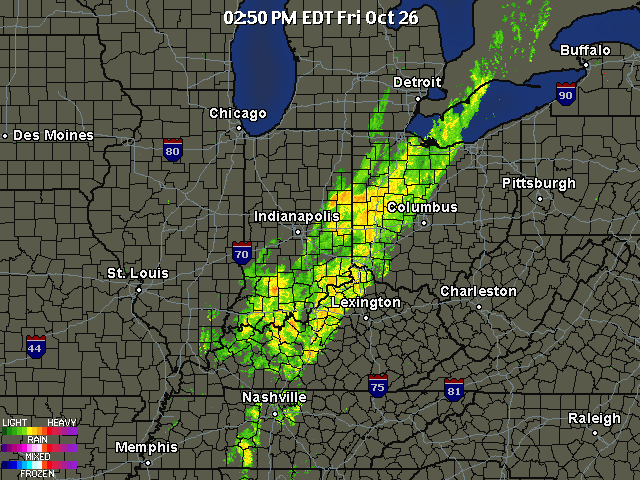
Radar Imagery from 2:50 PM today of the colds front and trough moving in from the west.

This trough will act to pull in Sandy from the SE hitting the NYC area. The max surge would be 15 feet. The trough will also give Sandy a boost of energy which will allow the storm to “bomb out” or undergo cyclogenisis (the rapid deepening or strengthening  of a low). The trough will then pull Sandy to the north through western MA and VT.

The cold front and trough will act to create the heaviest October rains ever recorded by taking moisture saturated air and slamming it into cold Canadian air which will mass condense it. The result? Up to 15″of rain for some areas.


The HPC (Hydrometerological Prediction Center) forecast for rainfall. This is in connection with the NHC track so these 15″+ amounts might stretch farther north into NJ and NY. Also, this is only to Wednesday, it will be raining all the way through Thursday for parts of Northern New England.

Speaking of cold air… there will be a snowy side to this system. The storm is very lopsided due to shear, and that will cause the storm to spin energy way to the NW of the center where the cold pocket aloft is. This cold pocket will help to create snow for Pennsylvania and any mountains north of NYC.

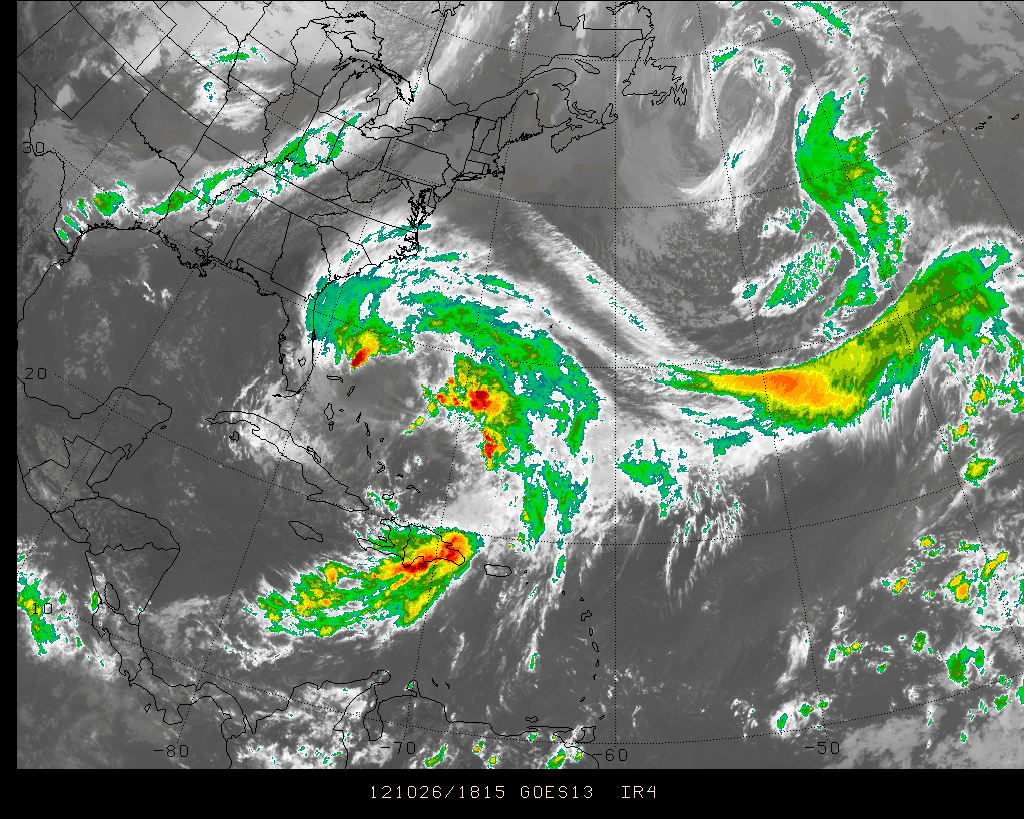
As you can see, there is no hurricane like anything in this inferred satellite image.

Instead is a mass of clouds that stretch all the way from the Caribbean Sea to the Del-Marva Peninsula. The east side has the most activity so even if the storm hits NYC, New England will feel harsh impacts. Although the east side is larger, the storm will grow substantially by the time of landfall and will be able to push activity well to the NW of the center.

-Jack


Large Storm to Impact Eastern Seaboard

There is a complex weather situation at play now as Hurricane Sandy moves up the Eastern Seaboard. The latest advisory puts Sandy as a 105mph Hurricane with a lowest pressure is 964mb. Sandy has just moved off the northern coast of Cuba.

Sattellite imagery of Sandy moving off of Cuba.

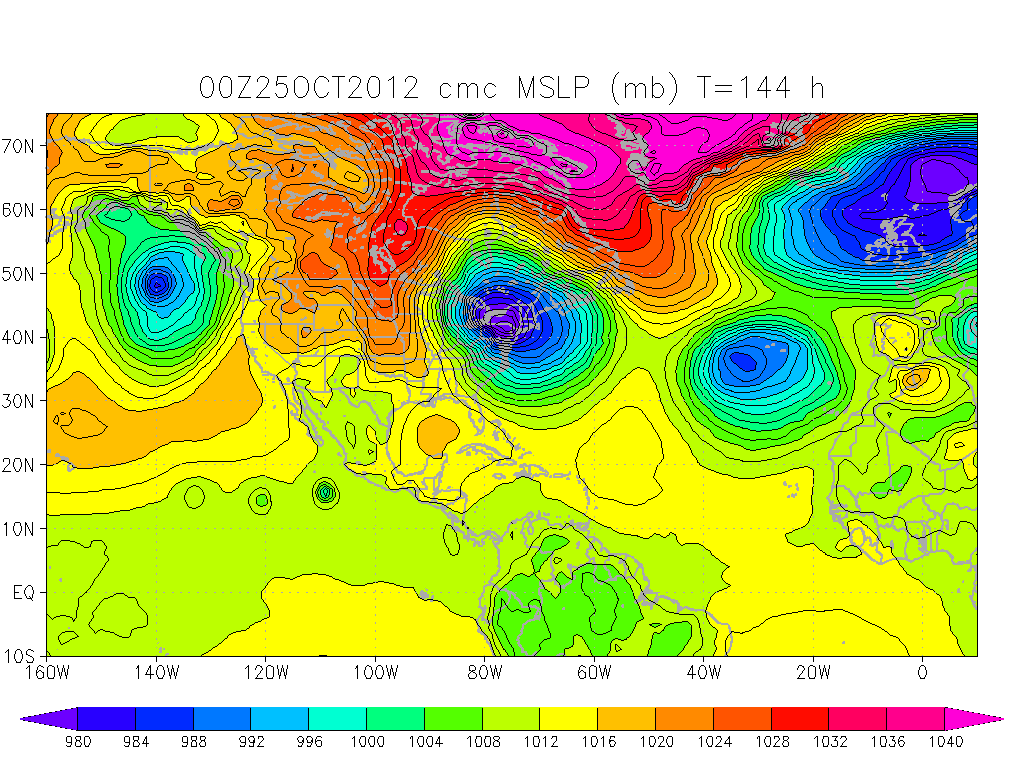
Now Sandy will continue moving north and then the second factor comes into play. This second factor is a trough of low pressure moving in from the west. This trough will pull in sandy towards the US. Sandy will then “bomb out” off of the NJ coast. Pressures will fall like a rock bottoming out near 949 mb. This is the general consensus of the numerical models. (These are super computers located around the world that take in weather data from around the world. Then this data is fed through a prisim of equations that produce graphs that we weather geeks/ meteorologists then interpert and make forecasts from).

Sandy will then be a Nor’Easter on steroids. This super-noreaster will then move into the coast south or on top of New York City. Surge flooding will be of great concern. There is a 5 foot seawall protecting the financial district from New York Harbor. This storm will be over 2500 miles wide and close to 3500 miles long. This huge storm will generate a 9-12 foot surge on top of the astronomical high tide caused by the full moon on Monday. This would most likely cause flooding in lower Manhattan.

There will be a snowy side to this storm as well. This will be the tropical moisture from Sandy moving up the coast meeting the arctic airmass behind the trough. Pennsylvania and Western New York State as well as the mountains from the Allegheny Mountains in Pennsylvania to the mountains near Mt. Katahdin, Maine could see snow.

CMC Numerical model plot for Mega Noreaster Sandy.

Snow amounts will be on the order of 4-8″ for lowland Pennsylvania to over 28-36″ on the higher peaks.

Rainfall will also be greatly enhanced by the warm moist air hitting the cold air from Canada causing the heaviest October rains in history. Rainfall amounts could reach over 20″. 12″ is expected over most regions.

Winds will be on the order of potentially 80mph in NYC where the worst of the storm will be. 55-70mph will be widespread with higher gusts. The coast of ME, MA, RI, CT, NY, NJ, and DE will see highest winds peaking around 50-65mph in many places. Exposed areas could get even higher gusts.

Timing will be Saturday-Monday for areas south of VA beach area, Sunday-Tuesday for CT to VA beach area, and Monday-Wednesday for New England.

Climate forecast

Winter 2012-2013:

There will be a weak El Nino and a likely negative PDO. In more simple terms, an area of moderately warm waters off the coast off Peru (El Nino) and Cooler waters off the SW coast of Alaska(Negative PDO). So what does this mean for the US? It means that the eastern seaboard will see cooler temperatures so it will be a cooler than normal winter for the eastern third of the country. Also this set of conditions favors a pattern known as the Greenland block. This is when a ridge of high  pressure sits over Greenland and causes the jet stream (which is a “storm highway” and the divide between warm and cold) to dive south into the Eastern US. This ridging will vary from week to week this winter and will not be as strong as 2010-2011. The East will see Above-average precipitation (likely in the form of snow due to below average temperatures. In the Center of the country there will be the other counterpart to the Eastern trough, the high where the jet stream rises warm air and dry air into the nations heartland causing lower than average snow levels and worsening drought. In the Western US it should be a fairly average winter other than the fact that the Pacific storms will be more powerful and more frequent.

Stay tuned!

-Jack