
All posts by Jack Sillin

I’m a third-year atmospheric science student at Cornell University who has been blogging about the weather since 2011. While I’m not officially a meteorologist, I have accumulated a bit of experience forecasting both local weather (in western Maine and New Hampshire) as well as national/international weather during my time writing for weather.us and weathermodels.com. I also have experience programming in Python, teaching concepts in weather forecasting, and communicating forecast information to general audiences.

Anatomy Of A Forecast Bust: Why The Pre-New Years Storm Was Snowier Than Predicted

Hello everyone!

In any field that requires making predictions such as meteorology, post-prediction verification and reflection is a key part of the job. I won’t ever be able to claim that I have a perfect forecast, but I owe it to all those who trust my forecasts to learn from the mistakes I inevitably make so that I don’t get tripped up again. That process of learning from busted predictions is why the weather forecasts you get from me or from elsewhere are so accurate despite the immense challenges associated with predicting the future state of the atmosphere.

With that in mind, as you might recall a few days ago we had a storm that I did an exceptionally bad job predicting. I expected 2-4″ to fall over the course of the day on Monday (December 30th) and some places reported over 8″. More snow fell on Tuesday which bumped storm totals well into the double digits not only in parts of the mountains where that was expected, but also in parts of York and Cumberland counties. Given that the nuances of mesoscale banding such as that which occurred on Tuesday are always hard if not impossible to pin down in advance, I feel pretty good about what happened during the second part of the storm’s evolution. Therefore this retrospective look will focus mostly on Monday.

Observed snowfall totals estimated from observations reported to the NWS office in Gray

I prepared Monday’s forecast fairly early in the morning, as per usual. I analyzed radar imagery, current observations, and forecast model guidance. Having spent a considerable amount of time over the weekend analyzing the storm for weather.us, I had a fairly solid mental model of what I anticipated would happen before I even opened my computer. All I needed to do was tweak my previous expectations to account for newly available information and summarize it for you all to read.

My expectation was that a batch of precipitation associated with the warm front of a storm over the Great Lakes would approach the region from the southwest during the morning hours. As it moved northeast into Maine, it would lose momentum due to a combination of low level dry air surging southwest from strong high pressure in Canada, and a loss of mid-level upward motion as the Great Lakes storm weakened and moved westward away from our area.

This forecast model image, posted in Monday morning’s update, highlights some of the reasoning behind my forecast for Monday.

As a result, I was expecting light snowfall accumulations around or below 2″ over SW ME and moderate snowfall accumulations between 2-4″ over NH (closer to the storm, and thus the upward motion needed for precipitation). I expected little to no snow across northeastern parts of the area due to the presence of very dry air in the lower atmosphere which would evaporate snowflakes before they could make it to the ground. Strong upward motion could have offset the effect of the dry air, but the fact that the storm was weakening and moving away from ME/NH supported forecast model guidance which suggested that the best upward motion would remain to our south.
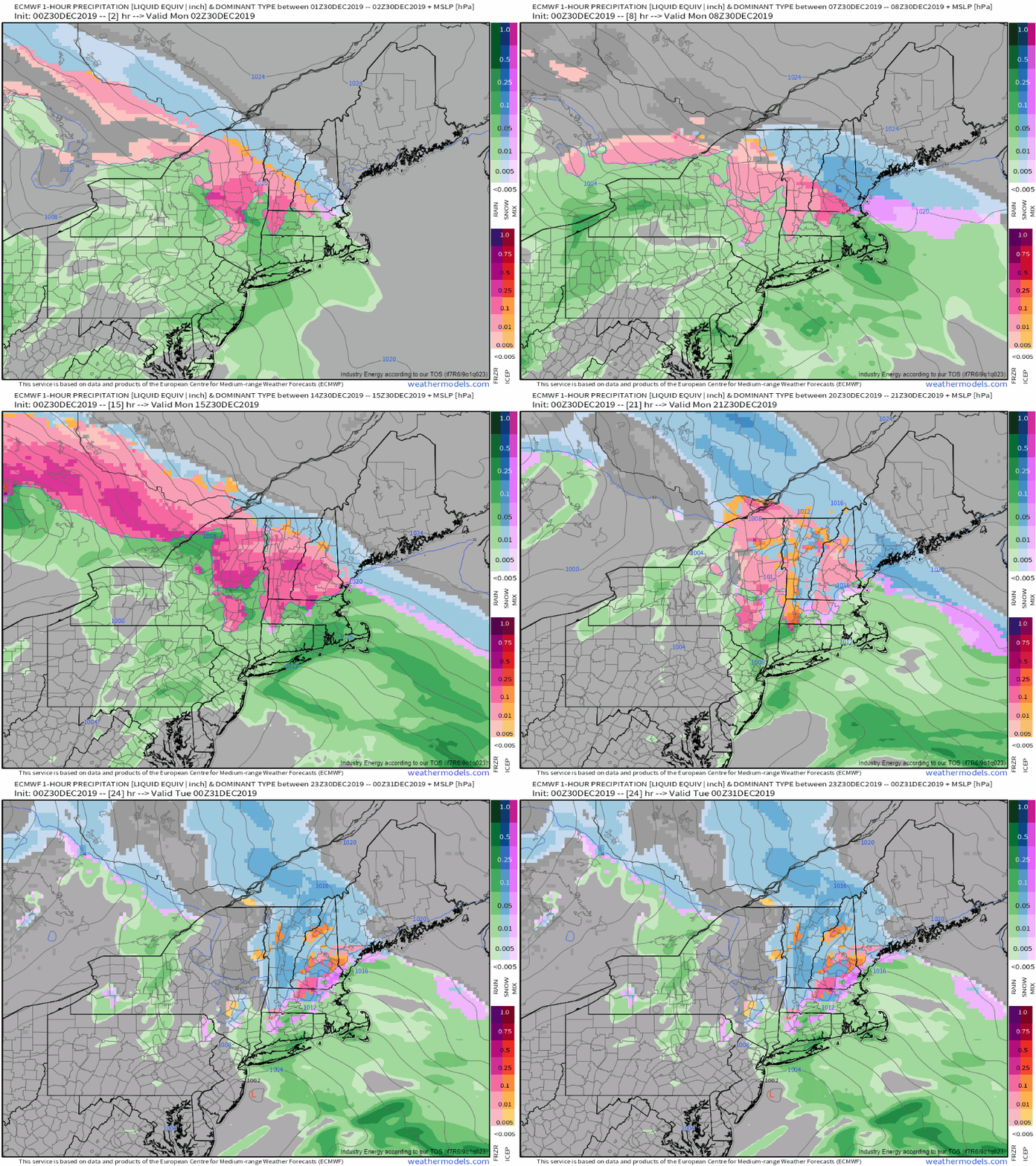
ECMWF forecast guidance available on Monday morning showed light to moderate snow struggling to push into northeastern parts of our region during the day on Monday.

Helpfully, forecast model precipitation guidance such as the ECMWF shown above was in agreement with my conceptual model based on a general understanding of the large-scale pattern. I actually thought the ECMWF was a bit too bullish on its forecast for precipitation given that it was overpredicting dew points in the airmass to our northeast (the air moving in from Canada was drier than the model thought) but I didn’t adjust my forecast too much in that direction.

Radar imagery available Monday morning showed precipitation receding as dry air worked into the area on a northeasterly breeze.

When I analyzed radar imagery, my conceptual model and the forecasts offered by model guidance seemed to be on track. A wide area of light to moderate snow was gradually receding as dry air surged southwest. The snow was perhaps a bit more widespread and intense than I would’ve thought initially, but the apparent error wasn’t all that noticeable except for folks in/near Lewiston who would wake up with a dusting of snow when I thought they would only see flurries at best.

Looking outside in Yarmouth, I saw about 2″ of snow which was towards the high end of what I thought might happen, but given that the dry air seemed to be approaching quickly, I didn’t give it too much thought. One tricky aspect of preparing a forecast early in the morning is that few people have stepped outside with their rulers by that point in the day. While radar imagery is helpful, it doesn’t tell me how much snow has actually fallen. The automated weather stations located at airports across the area are very helpful too, but most of them don’t report snowfall totals until 12z (7 AM) which is after I sent my forecast. Perhaps if I had known there was already 4″+ on the ground in parts of central NH and interior SW ME, I could’ve adjusted my forecast to be a bit closer to what actually happened.

With forecast model guidance and my mental model in good agreement both with each other and with the observations I was analyzing, I went ahead and typed up my forecast with fairly high confidence. In hindsight, that confidence was misplaced.

The key error I made on Monday was putting too much trust in the ability of forecast models to accurately predict the upward motion needed to generate precipitation. Instead of analyzing the wind and temperature fields and using my knowledge about what physical processes can produce upward motion in the atmosphere, I trusted the models to do that work for me.

Because the volume of data available to forecasters is so enormous, there will always be a need to place some amount of trust in the models. The human brain just can’t process that much information in a reasonable amount of time. One of the skills that’s becoming more important as our world becomes oversaturated with data is sorting the signal from the noise. When can we accept what’s given to us (by models) verbatim and when do we need to dig into the weeds and figure things out for ourselves? This problem isn’t unique to meteorology.

The map below is a bit noisy but to the eye of someone who has spent far too much time digging into forecast model guidance, it should scream heavy snow across central NH/SW Maine. Winds and temperatures at 700mb (about 10,000 feet) are plotted along with relative humidity at 700mb (thin contours) and 850mb or ~5,000 feet (shading). The model’s forecast for upward motion is also plotted in orange contours.
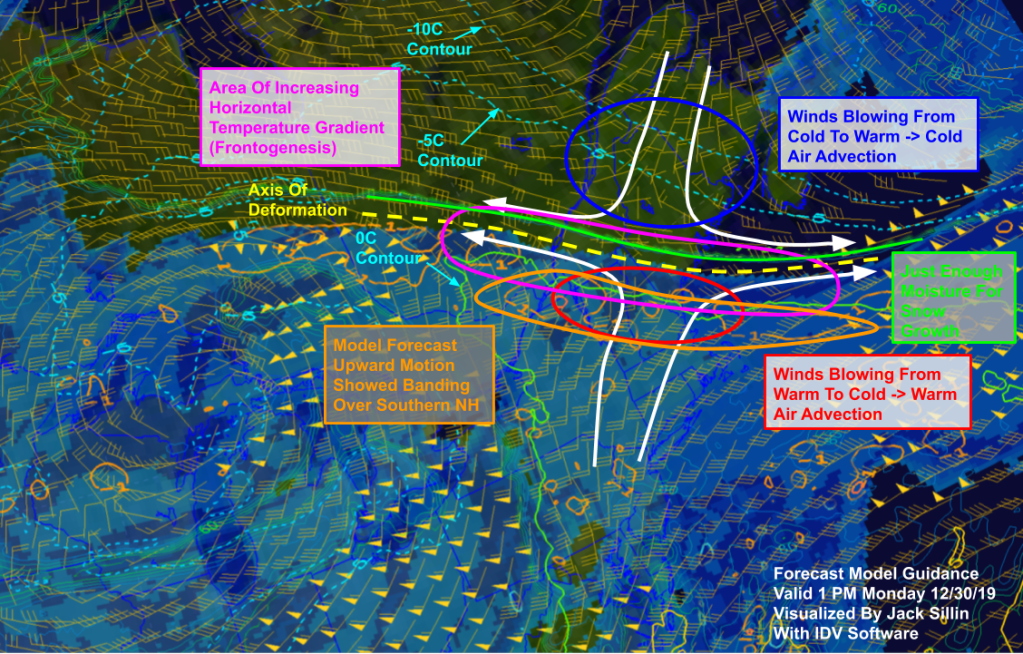
Forecast model guidance valid 1 PM Monday shows (in retrospect) a setup ripe for narrow bands of heavy snow across central New Hampshire/SW Maine.

If we focus on the 700mb winds and temperatures for a minute, we can see that Maine is at the center of something called a “deformation zone”. This happens when winds blowing from opposite directions run into each other. In our case, northeasterly winds moving in from Quebec are crashing into southwesterly winds advancing from the Mid Atlantic. Deformation zones are often focal points for heavy banded precipitation because when two airmasses crash into each other, upward motion develops via a process known as frontogenesis. For a more in-depth look at frontogenesis and why it leads to upward motion, check out my article for weather.us which digs into that process.

SPC RUC objective analysis showing strong deformation and related frontogenesis across central NH and SW Maine on Monday afternoon.

Sure enough, objective analysis products valid 1 PM on Monday show a narrow zone of frontogenesis producing heavy snow located just south of the deformation axis. This is consistent with the forecast model guidance analyzed above, and would also be consistent with the large scale setup visible on satellite imagery. A close look at the fundamentals (wind/temperature/moisture) in the mid levels would have made it pretty clear that heavy banded snow would continue through most of the day on Monday across central NH and SW Maine. Unfortunately, I figured that the model’s prediction of strong upward motion over MA/SW NH was reasonable and kept heavy snow out of the forecast.

In short, the forecast bust on Monday resulted from a model error that I failed to catch because I didn’t think to double check the relevant part of the model’s analysis. In retrospect, this seems pretty obvious but without the answer key, it’s very difficult to figure out where model guidance is doing a good job and where it might miss a key feature or two.

Given that I don’t have the capacity to double check every aspect of the model’s work, choices must be made about what information to accept verbatim and what to analyze more closely. I think the biggest lesson I’ll carry away from this storm is that paying closer attention to the fundamentals (wind/temperature/moisture) instead of derived parameters (such as upward motion) is valuable, especially in tricky setups like this. In situations where the fundamentals are telling a different story than the derived parameters, I should be better about trusting my knowledge of the fundamentals rather than leaning on the model-derived parameters.

I would like to apologize again for any inconveniences caused by the forecast error on Monday. I would also like to say thanks for the understanding so many of you have expressed in the past few days. Most meteorologists have inboxes and comment sections full of hate mail after a busted forecast. I have yet to receive a single negative message about the recent storm. Given the state of the internet as we enter 2020, I think that’s pretty cool.

-Jack
Milder And Cloudy Today

Hello everyone!

Today will feature mild and cloudy weather as a weak storm system moves by to our north. Light SW breezes on the southern side of this system will be responsible for the warmer air. High temps will range from 35 in the mountains to near 50 in SW NH. The system to our north will be too weak and moisture-starved to produce any precipitation outside a brief flurry over the mountains. Our next round of precipitation will arrive tomorrow once cooler air has returned, and is likely to fall as light to moderate snow.

-Jack

Another Quiet Day Today

Hello everyone!

Today will feature more quiet weather as high pressure meanders offshore over the Mid Atlantic. Skies across the region this morning feature a mix of sun and clouds and that trend should generally continue through this afternoon, though the balance will shift a bit towards cloudier conditions later this evening. Milder temps will continue as warm air slowly filters northeast behind the departing high pressure. Highs will range from around freezing in the mountains to 45 along the NH Seacoast. No precipitation is expected today as our next storm system remains well to the west.

-Jack

Quiet Weather Returns TOday

Hello everyone!

Today will feature the return of quiet weather as the storm that has been impacting the region over the past few days moves away to the northeast. Behind the system, expect WNW breezes to set up our classic upslope/downslope pattern in terms of temps, precip, and cloud cover. The mountains and northwestern foothills can expect mostly cloudy skies, intermittent snow showers, and temps in the upper 20’s to low 30’s. The coastal plain and southeastern foothills will see partly to mostly sunny skies, dry conditions, and temps in the mid to upper 30’s.

Enjoy the nice weather, and I hope you have a great start to 2020!

-Jack

Steady Snow For Most Today, Some Rain Along The Coast

Hello everyone!

Today will feature the second part of the complex storm system that has been impacting the region since Sunday evening. A new area of low pressure formed offshore last night and is moving northeast into the Gulf of Maine this morning. Bands of heavy precipitation to the north and northwest of this low will impact the region today before the system moves into the Canadian Maritimes tonight.

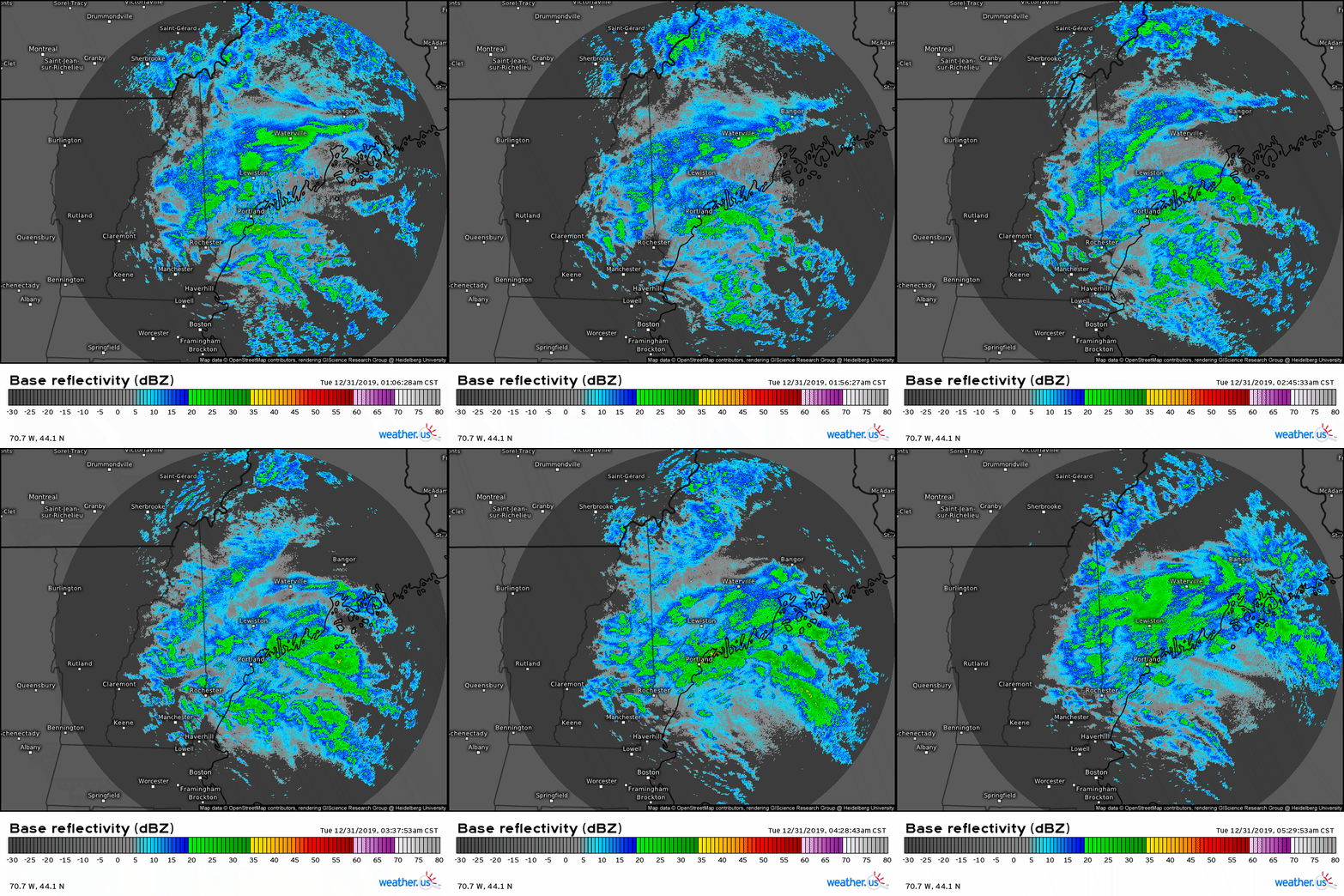
Radar imagery this morning does a good job highlighting the area of steadiest/heaviest precipitation along the Maine Coast and adjacent parts o f the foothills. The mountains are experiencing a bit of a lull in precipitation currently, but heavy snow will return there in the next couple hours.

Temperatures this morning are generally in the upper 20’s across most of the region, with the immediate coastline south of route 1 along the midcoast and east of the Turnpike/295 between Brunswick and Kittery reporting temps in the mid 30’s. Warm air should have a pretty hard time making it much farther west than it is now given that the low is passing to our east, which means winds across the area are generally from the north or northeast.

Here’s the latest NWS forecast for additional snow between 6 this morning and the end of the event. There’s still lots of snow yet to fall across the mountains and northeastern foothills with an additional 6-10″ likely to fall today and tonight. I suspect the snowfall gradient will be a bit sharper along the coast than currently advertised as the coastal front keeps a relatively sharp rain/snow line. Given relatively cooler air aloft, not too much in the way of sleet or freezing rain is expected though a brief period of mix is possible along the I-95 corridor where the coastal front might be a bit farther west at 2,000-4,000 feet than it is at the surface.

Rain, snow, and mixed precip will taper off this evening from SW to NE as the storm moves away. Temps will generally stay close to where they are now, in the mid 20’s for the mountains, upper 20’s for the foothills and most of the coastal plain, and mid/upper 30’s for the shoreline.

I’d like to end this post with a brief acknowledgement that yesterday’s forecast turned out absolutely terribly. Low level dry air was expected to halt the advance of precipitation around the NH/ME border, and given the dry air and lack of mid level dynamics, the precipitation that did fall was expected to be relatively light. Instead, a narrow band of heavy snow developed from Central NH to Cumberland County ME and dumped over 6″ of snow, when not more than 2-4″ was expected. I apologize for any inconvenience this error caused. I’ll take a closer retrospective look at this event when the dust (and snow) settles in a couple days and will publish my findings here.

-Jack

First Round Of Our Complex Storm Arrives Today

Hello everyone!

Today will feature the arrival of the first part of the complex storm system that will be impacting the region between now and New Year’s. The center of the storm is currently located over eastern Michigan and is moving north-northwest. Because the storm is located so far to our west and a very strong area of high pressure is anchored over Quebec, precipitation will have a hard time advancing through the region today.

Morning radar imagery shows steady precipitation confined to southern and western parts of the area, with the exception of SW NH where dry air aloft has already moved in. Snow is falling across most of Maine and north-central NH with the brighter echoes over south-central NH indicating the presence of warm air aloft, and thus mixing with sleet/freezing rain.

Forecast guidance for later this morning shows a similar setup to what we’re seeing now. Cold, dry air will continue moving in from Canada on north-northeasterly winds which means precipitation will struggle to make much northeasterly progress. If it’s currently snowing where you are, you’re likely to see snow for much of the day today with accumulations of 2-4″. If you’re northeast of a Brunswick-Bethel line and are currently dry, you’ll likely stay mostly dry today with little more than flurries.

Farther southwest in NH, freezing rain and freezing drizzle are being reported. Ice will continue to accumulate today with total accretion amounts between a quarter and a third of an inch.

High temps today will range from 20 in the north to 30 along the coastline.

The storm’s second act will arrive with heavy snow tomorrow morning.

-Jack

Complex Storm Approaches Today

Hello everyone!

A complex storm system will begin approaching the region from the west today, though it will be in no rush to get here. As a result, expect clouds to increase today while any precipitation evaporates before it can hit the ground. Filtered sunshine during the morning hours will help push temps back above seasonal averages before a reinforcing shot of cold air arrives tonight. Expect highs to range from around 30 in the north to around 40 in SE NH.

Some snow/sleet is possible late this evening (after 9 PM) in SW NH but overall, dry weather is expected. I’ll take a more in-depth look at the storm in tomorrow’s update as precipitation will start to fall in the SW half of the region tomorrow morning before spreading NE tomorrow night.

-Jack

Skies Slowly Clear Today

Hello everyone!

Mostly cloudy skies this morning will slowly give way to more sunshine as we move into this afternoon thanks to the arrival of a cooler and drier airmass from Canada. That new airmass will be arriving on NW breezes which will keep the mountains the cloudiest due to upslope flow. Those breezes aren’t expected to be all that strong which means it’ll take a while for the colder air to make its way over the Appalachians. With that in mind, another day of relatively mild weather is expected. High temps will range from 30 in the north to a little above 40 along the coastal plain.

Our next storm system will slowly arrive from the west beginning tomorrow, though it will take until late Monday night for snow to begin falling north or east of Portland. I’ll have more information on that system in subsequent updates.

-Jack

Light Mixed Precip Today

Hello everyone!

Today will feature light mixed precipitation as a weak cold front moves through the region. Radar imagery this morning shows a band of steady but light precipitation moving through northern and northeastern parts of the area as of 8:45 AM with a bit more still off to our west. Temps along the coastal plain are above freezing this morning, which means that plain rain is falling. Farther inland, temps at the surface are below freezing which means a mix of sleet and freezing rain is expected. While no significant ice accretion is anticipated, it only takes a thin glaze on untreated surfaces to make them quite slippery!

Precip will taper off as the front passes this afternoon. A few breaks in the overcast are possible across NH before sunset but otherwise expect mostly cloudy skies region-wide. Highs will range from 35 in the north to 45 along the southern coast.

-Jack

Clouds Increase Again Today

Hello everyone!

After a mix of sun and clouds yesterday, we’ll see a return to mostly cloudy skies today as our next storm system begins its approach from the west. This system’s precipitation won’t arrive until very early tomorrow morning, and will fall in the form of freezing rain inland/plain rain along the coast. No significant accumulations are expected, though untreated surfaces will be slippery away from the coast by tomorrow’s morning commute.

High temps today will remain a bit warmer than normal, ranging from 25 in the mountains to 40 along the NH/MA border.

-Jack