Today will feature the beginning of our major winter storm/blizzard set to slam the region tonight into tomorrow morning. Look for cold and cloudy conditions this morning to give way to snow by around noon. SW coastal areas will see light ocean effect before then and it may take until the early afternoon for NE sections to get into the snow. Snow will quickly become moderate to heavy as we get into the evening hours. Strong WAA forcing will result in bands of heavy snow before the real storm even develops offshore. We’ll have to wait until the early morning hours tomorrow for the real show to get on the road as the coastal low bombs out offshore.
I’ll have updated analysis and forecasts for the blizzard this afternoon as more observations come in. Until then, check out my post from last night for all the details.
Our active pattern is about to go into overdrive as a storm will approach from the west tomorrow before rapidly intensifying off the MA coast tomorrow night and into Monday morning. Light ocean effect snow will arrive tomorrow morning along the southern coast before moderate bands of snow arrive tomorrow afternoon associated with the primary storm. It won’t be until late tomorrow night into Monday morning that the secondary low cranks offshore bringing heavy snow, gusty winds, whiteout conditions, and potentially even thundersnow.
18Z 3km NAM Showing Light Ocean Effect Snow Ahead Of The Main Event Sunday Morning. Image Credit: Tropical Tidbits
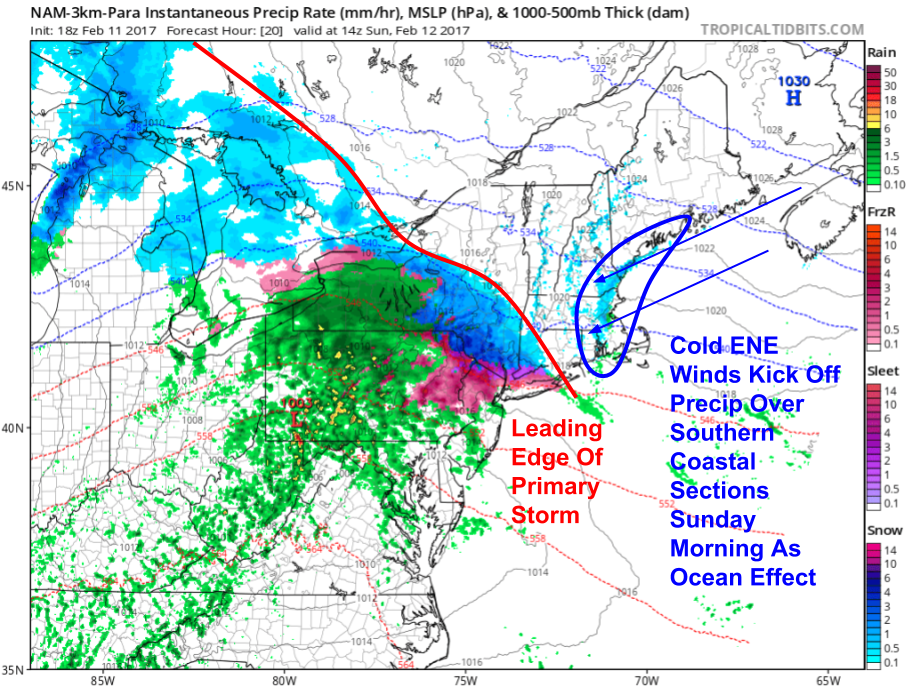
As cold high pressure noses in from the north tonight and tomorrow morning, winds will turn east-northeasterly resulting in some ocean effect snows along the coast SW of the midcoast. These will be fairly light and should only amount to an inch or two through the morning hours. The first part of the main event arrives a little later in the morning as the primary low pressure system approaches from the west.
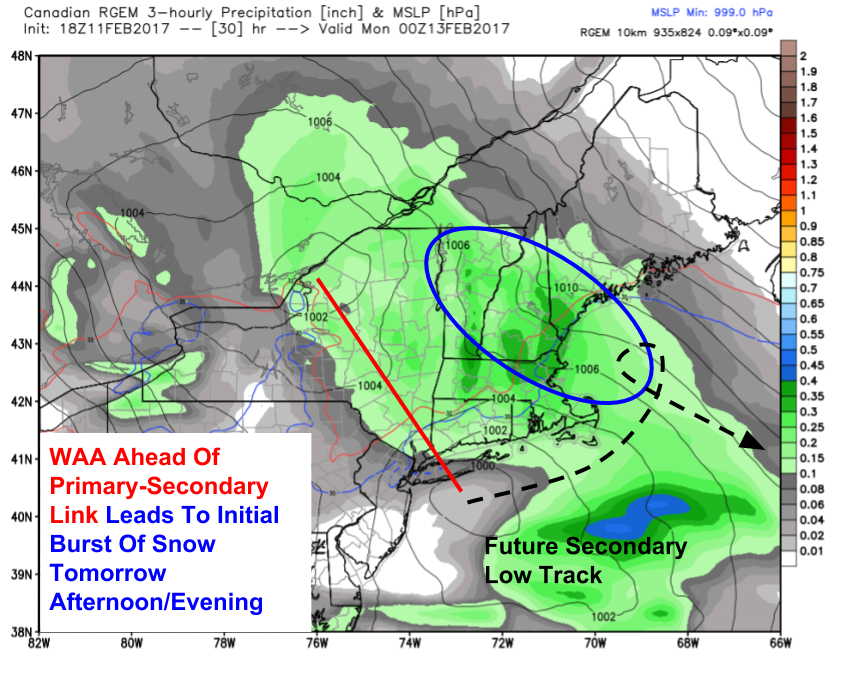
The first impactful round of snow will arrive from SW to NE tomorrow midday. It will be associated with the warm air advection aloft ahead of the primary low pressure system that will be weakening as it moves through NY state. The warm air overrunning the low-level cold air will produce moderate bands of snow for the entire area. Several inches of accumulation are likely to be associated with this. At this time, the secondary low will be in its infancy over the waters S of Long Island.
12Z GFS Progression Of 500mb Vorticity From Sunday Evening Through Monday Morning. Image Credit: Accuweather
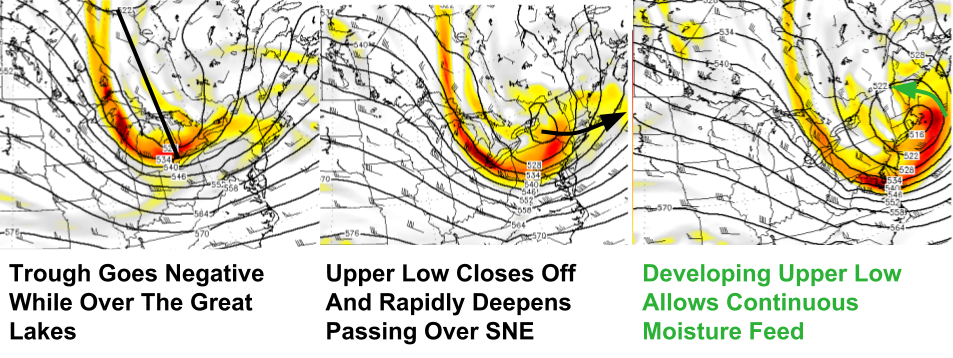
The real show begins when upper level energy diving SE through the midwest arrives at the coast and enables the secondary storm to explosively deepen. Model guidance suggests the low could deepen 28mb in 12 hours as it moves across Cape Cod and into the Gulf of Maine overnight Sunday and into Monday Morning. It’s during this phase that the real show occurs.
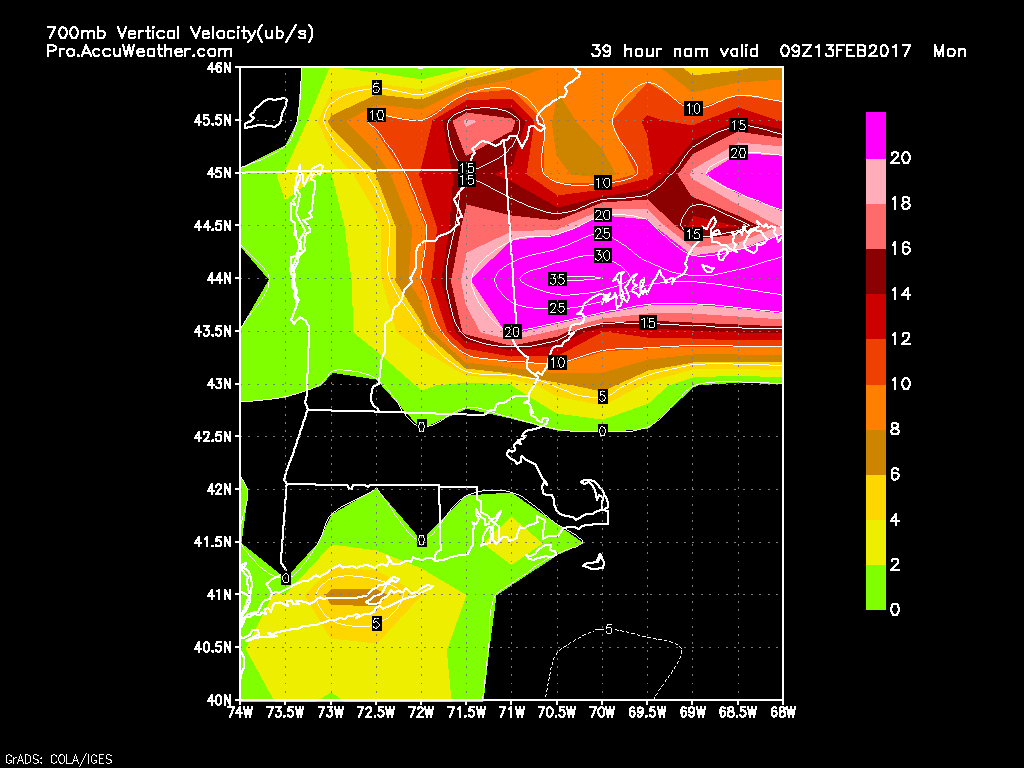
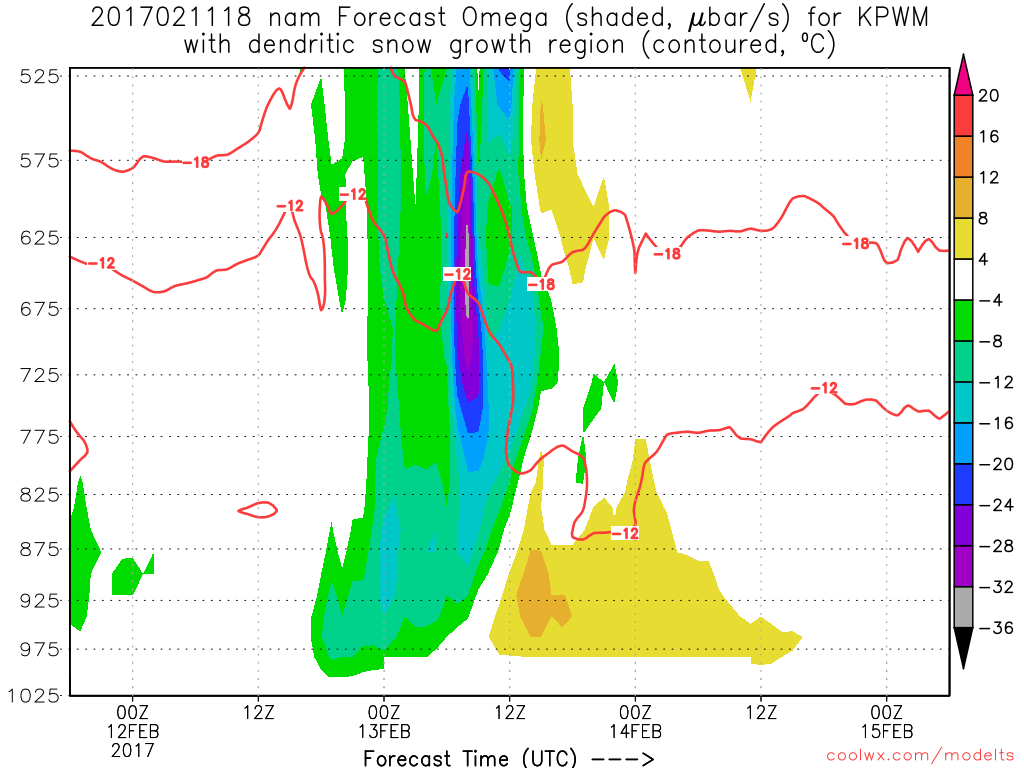
When storms deepen that explosively, a number of really cool things happens. First, it snows really hard. This map from the 18Z NAM shows a band of absolutely insane upward motion on Monday morning. Look for snowfall rates on the order of 2-4″/hour or more in the heaviest mesoscale bands. It’s important to note that it’s impossible to predict where these bands will set up more than a few hours in advance. At the moment, coastal Maine looks like the best bet for one of these bands though it’s far too early to say exactly which towns end up under it. For the science behind mesoscale banding, be sure to check out my post on the matter from our last storm only a couple of days ago!
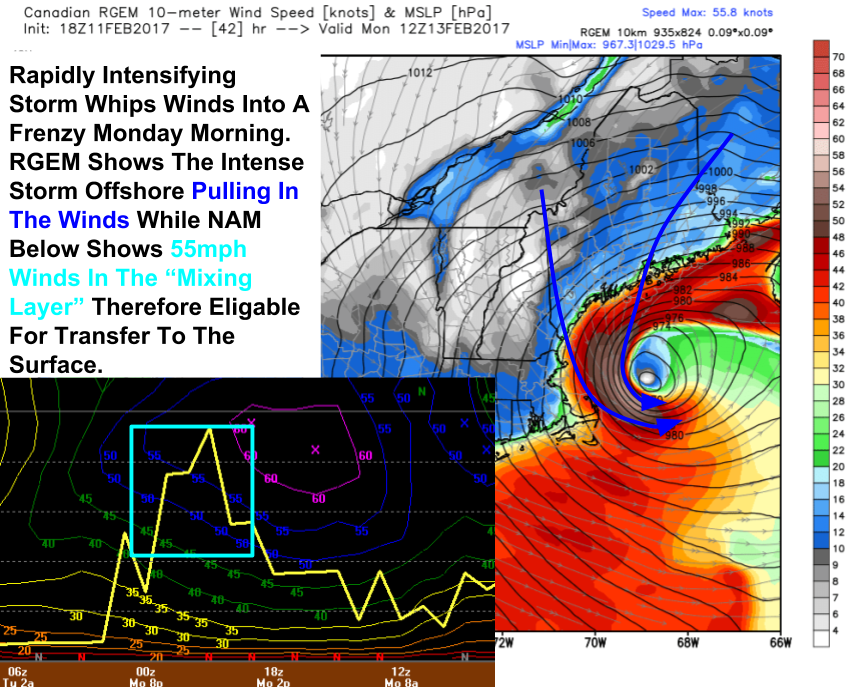
18Z NAM And RGEM Models Showing Intense Winds Monday. Images From BUFKIT and Weatherbell
The second cool thing that happens is that it gets really windy. As the pressure gradient tightens between a low that has the same pressure as a category 2 hurricane and a strong high pressure system nearby, the winds will take off Monday morning. Look for gusts along the coast in the 50-60mph range with 30-45mph winds away from the coast. Just be thankful the storm isn’t another 50 miles west or we’d be getting into the hurricane force winds lurking just offshore. Not a good day to be out on the water! Winds this strong plus the threat for heavier/wetter snow along the coast will mean power outages are likely Monday for coastal communities. If you’re especially vulnerable to power outages, be prepared to be in the dark Monday night!
The other impact of the winds is that they’ll be blowing around the snow both from today and from the storm. Look for visibilities to approach zero Monday morning as the winds develop. The result will be blizzard conditions and a blizzard watch is out for the coast for Monday. Only travel Monday morning if it’s an absolute emergency!
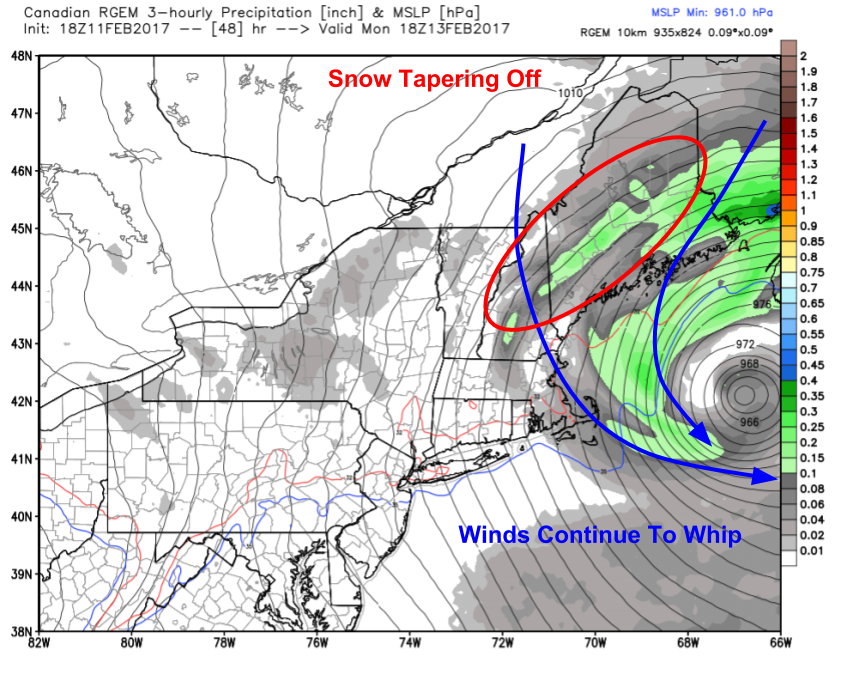
Snow will wind down Monday afternoon as the storm pulls away to the east. While snow will diminish in intensity and eventually taper off, winds will still be going strong resulting in continued low visibility/blizzard conditions through the evening hours Monday. Winds will calm down Monday night into Tuesday morning.
While coastal flooding is always a concern with storms this strong, winds will be mostly out of the north and will probably push more water offshore than onshore in most areas. However, the intense winds will generate very large waves which will likely cause beach erosion and even some minor splashover in the typical spots. High tides to watch will be 12 AM and PM Monday.
18Z NAM Showing Intense Upward Motion Through The Dendritic Growth Zone Monday Morning. Image Credit: Coolwx.com
So will this snow be cement or fluff? The answer is, for most, fluff, and for some along the coast, a mix. To get fluffy snow, you need cold temps, strong lift through the snowflake production zone (-12C to -18C, wherever in the atmosphere that happens to be) and you need the snowflake production zone (aka dendritic growth zone) to be full of moisture. We have all the ingredients for fluff away from the coast. However, at the immediate coast, temps will begin on the warmer side and as a result, some heavier/wetter snow could kick things off Sunday evening resulting in the threat for power outages there.
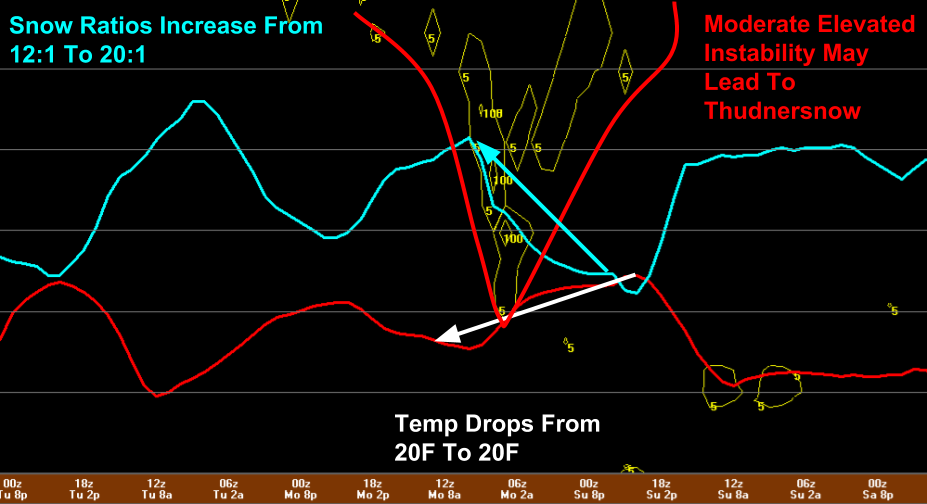
18Z NAM Showing Different Dynamics Monday
Here’s a plot from the 18Z NAM showing various parameters for Portland through time (which moves forward from right to left along the x-axis). Notice the sharp increase in snow ratios (light blue line) going from a typically heavy 10:1 ratio to a very fluffy 20:1 ratio as temps cool from 30F to 20F. Also notice the presence of instability aloft. That combined with tremendous upward motion means we could be woken up by claps of thunder Monday morning. Hopefully we’ll get the continuous thundersnow parts of CT saw with the storm Thursday but even one strike would be cool! Keep your eyes and ears open!
Total Snowfall Forecast Through Monday Evening
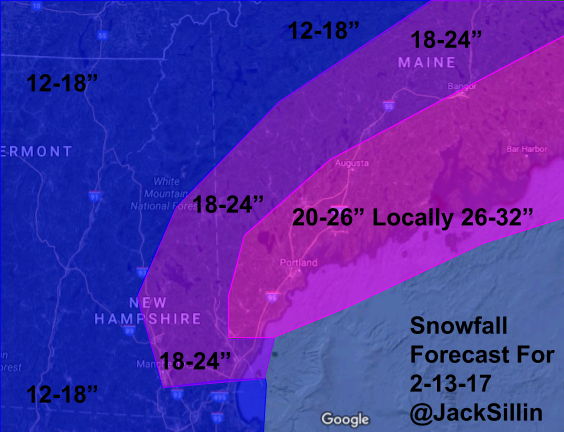
Here’s how much snow I think will fall. QPF values (liquid equivalent) range from a little under an inch north to over 2″ on the coast. Given fluffy ratios away from the coast, that inch could quickly turn into 18 or even 20 but confidence in the full inch falling is low enough for a 12-18″ forecast for the mountains. Along the coast, around 2″ of QPF is forecast but some of that will fall at lower ratios (or else we’d be looking at over 3 feet!) which means amounts will be held back to right around the 2 foot mark. In a band or two near the midcoast, I wouldn’t be shocked to see a 30″ report based on the fluff factor that will begin to set in as the storm wears on. I’ll adjust these numbers with any new data tomorrow morning!
More updates tomorrow both here and on twitter @JackSillin.
Quick update this evening as I’m at the USM track for an indoor track meet. I’ll focus this update on the light to moderate snow tomorrow, leaving our Monday blizzard for when I have more time.
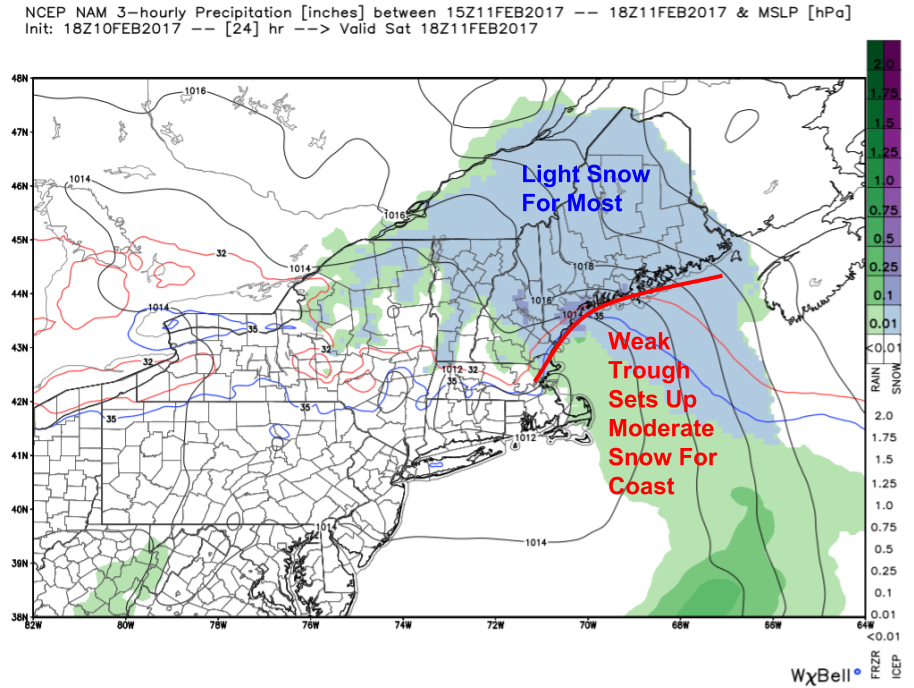
18Z NAM Showing Light To Moderate Snow Tomorrow Afternoon. Image Credit: Weatherbell
Light snow will develop early tomorrow morning for most. Light snow will continue through the day away from the coast where moderate snow will develop in the early afternoon as a coastal front sharpens up just offshore. Temps will rise slowly into the mid 20’s north and the low 30’s south. The precip should remain all snow and it should be of the fluffier nature.
12Z GFS Showing Weak Energy Approaching Tomorrow With Stronger Energy Over The NW Plains For Monday. Image Credit: Accuweather
The weak nature of the precip will be a result of the weak nature of the energy aloft. Notice the lack of deep reds/oranges along with only a weak dip in the height lines. This indicates forcing for precip will be limited at best and most of it will come outside the dendritic growth zone in the lower levels. So how much snow should we expect?
Snowfall Forecast Through Tomorrow Evening
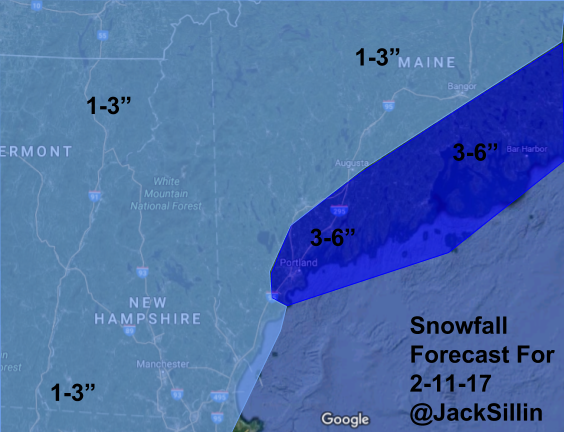
Here’s the current forecast. The heaviest amounts will be across the midcoast where a few 5 or 6″ amounts are possible. Most will see 1-3″ with 4-5″ amounts along the coast NE of Portland.
Our next storm will arrive Sunday afternoon and crank away into Monday. An early look at amounts shows 1-2 feet are likely for many with a few midcoast spots possibly eclipsing the 2 foot mark. I’ll refine and explain these amounts tomorrow evening. In addition to the snow, winds will crank up behind the low pressure system resulting in blizzard conditions along the coast. Another storm could bring significant snow to the region again late in the week. Welcome to winter!
After several days of fairly active and interesting weather, we’ll get a day (and only a day) off today. Skies will be party sunny, temps will be very cold, and winds will keep blowing the snow around but for the first time since Monday and the last time until Tuesday, we won’t be adding to our snowpack. Look for highs in the low single digits above zero north and in the high single digits to low 10s in the south. Winds will be zooming out of the NW towards our developing storm at 30mph this afternoon so the wind chill will make things feel even colder. The winds will also blow around our new fluffy snow resulting in more slick spots and occasional low visibility.
Our next little storm will arrive late tonight into tomorrow and our next potentially big storm will roll in Sunday night.
We’re now locked into what looks to be an extremely active pattern for cold and snow with today’s system wrapping up tonight, a clipper system bringing light to moderate snow Saturday, a coastal storm potentially bringing a major snowstorm Monday, and another coastal storm threatening in about a week. I’ll go over what we know, what we don’t know, and some of the mechanics behind each storm below. Welcome back to winter!
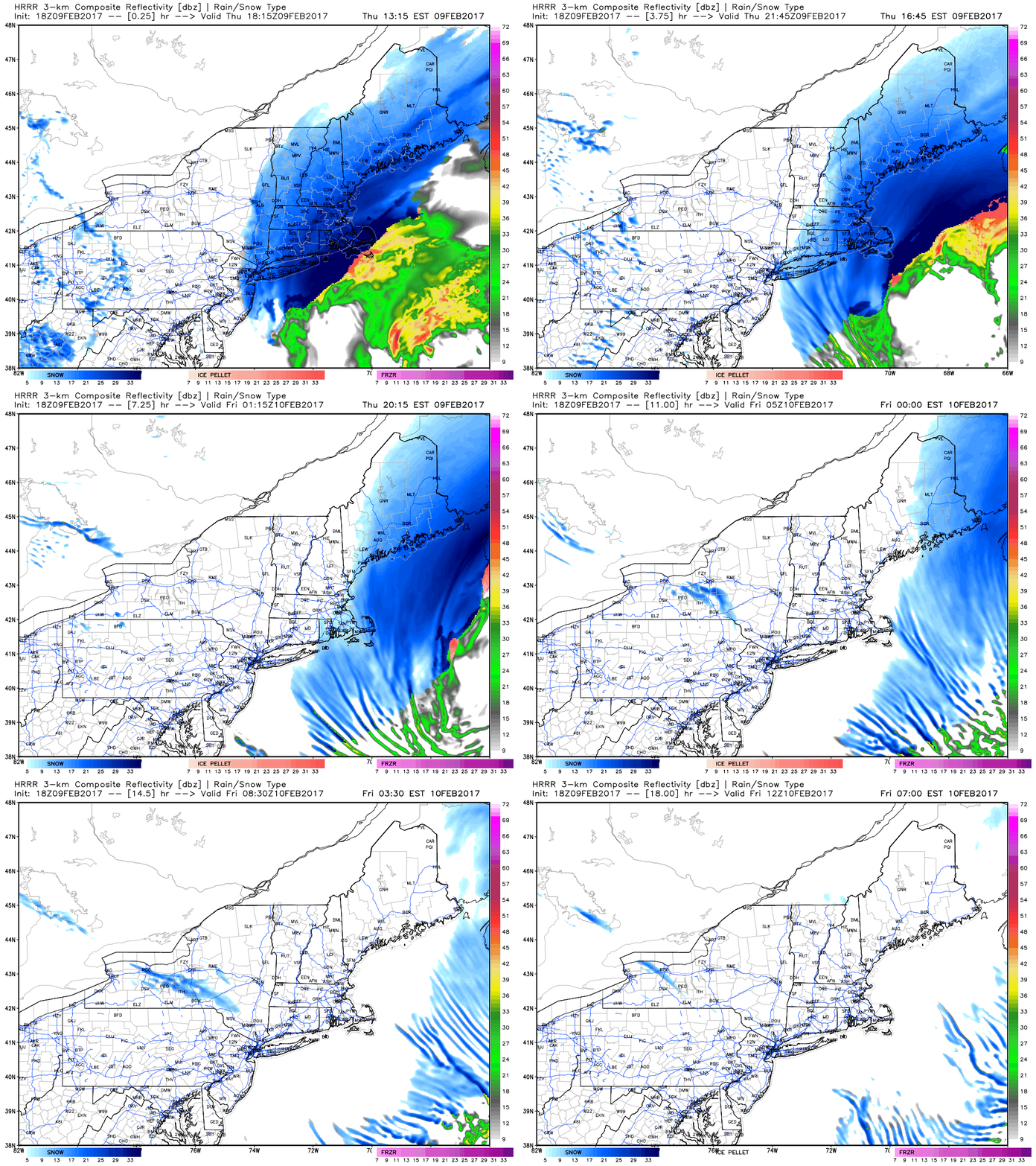
HRRR Model Showing Snow Winding Down This Evening. Credit: Weatherbell
The current storm will wind down this evening as the coastal storm moves offshore. Here’s a simulation of what that will likely look like from the HRRR model. There was plenty of mesoscale banding today, for some of the science behind that phenomenon, check out my post from this afternoon. An additional several inches of snow are expected before things wind down later this evening. Gusty NW winds will bring in very cold temps for tonight and tomorrow resulting in very low (subzero) wind chills and the continued threat for blowing/drifting snow.
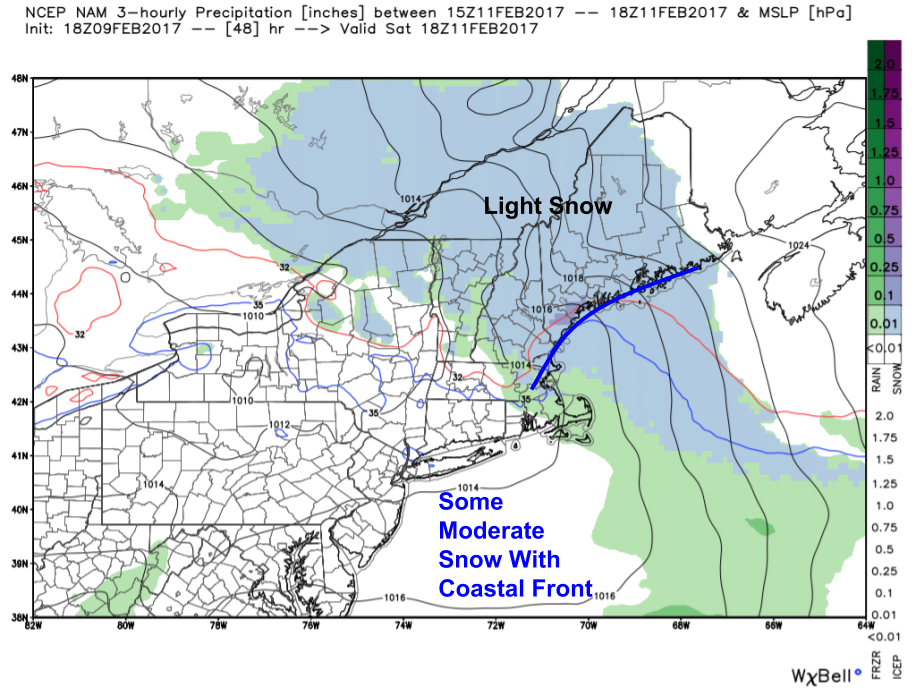
18Z NAM Showing Light Snow Saturday Afternoon. Image Credit: Weatherbell
Light snow will develop early Saturday morning and will continue through the day. Snow will be light for most but a little coastal front/mesoscale low pressure system will likely enhance snowfall along the coast. Most folks will end up with 1-3″ though the coast is likely to see 2-4″. With the fluff factor in place due to cold air, there’s an outside chance someone ends up with 6″ but that seems unlikely at the moment. Snow will taper off Saturday night.
12Z GFS Showing An Upper Level Setup Favorable For Rapid Intensification Monday. Image Credit: Accuweather
Our next system will take shape Sunday night into Monday. Considerable uncertainty still exists though if current forecasts from guidance verified, we would be in for a major snowstorm. All the typical threats are looking likely with heavy snow, high winds, and coastal flooding all on the table. This storm has the potential to rival some of the blizzards of the past few years so stay tuned to the latest updates as confidence increases. Of course it wouldn’t take much of a change in the timing of a couple disturbances to result in a much more benign event though at the moment that looks unlikely.
Depending on the intensity of the system, snow could linger into Tuesday before moving out. We’ll have a break for most of the day Tuesday before another storm threatens for Wednesday into Thursday. With such a chaotic pattern, it’s far too early for amounts but it’s definitely something to keep an eye on as our active pattern rolls on!
Various Teleconnections Showing Active Weather Continuing For The Next 2 Weeks And Possibly Beyond. Images From CPC.
Looking farther out into the future, the pattern across both the tropics (MJO, top left) and the Northern Hemisphere (PNA, AO, NAO, right column) show a pattern favorable for New England snowstorms though at least the next two weeks. While it’s impossible to pin down individual threats past 7 days and it’s entirely possible that for any given threat the pieces don’t come together just right for a major (or even minor) storm, it does look like we’re in for a good little ride as we let the rest of February go by. Buckle up and enjoy the show!
I sadly will be preoccupied tomorrow evening with a most unworthy pastime (5 hour indoor track meet, ugh!) but I’ll have more this weekend.
As our storm today continues dumping heavy snowfall across much of the area, I figured I’d take some time to explore mesoscale banding: the reason why some towns will be buried in snow today and why others right nearby will see much lighter amounts. The atmosphere is set up perfectly for mesoscale banding which makes this a great time to learn about the phenomenon.
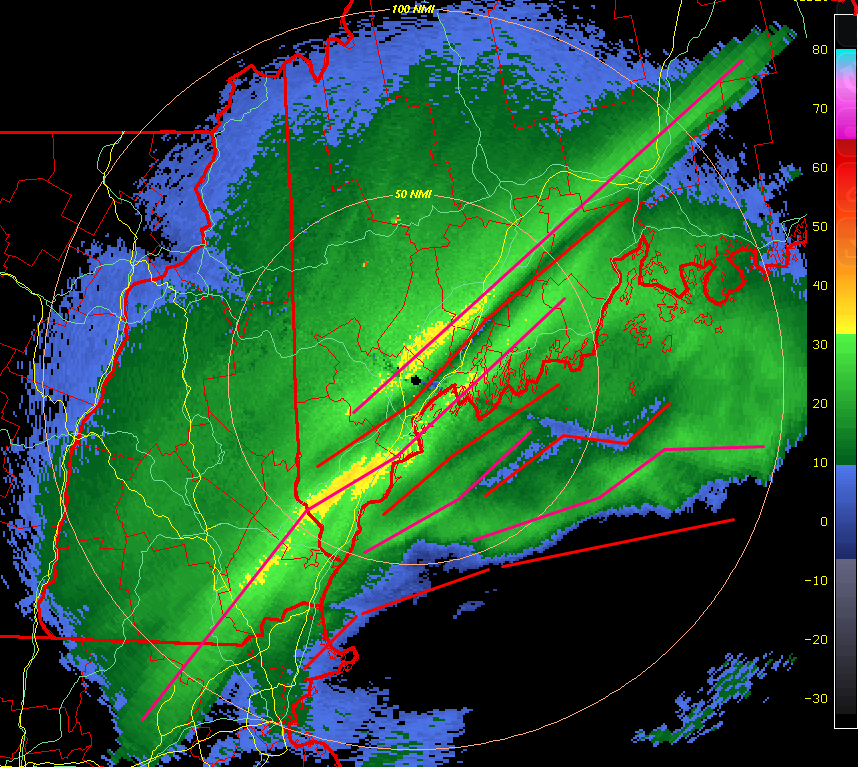
Radar Showing Intense Banding Late This Morning. Image Credit: COD
Here’s one of the best examples of mesoscale banding you can find brought to you by today’s storm. Snow was coming down at rates of 2-4″/hour over Portland and Lewiston in the heavy bands (purple lines) while at my house in Yarmouth, we got a measly .4″ during the same period (11AM -12PM). Even better, these bands hardly moved throughout the morning and aren’t going anywhere as of this writing at 1 PM meaning there will be intense snowfall gradients as some downs hit the jackpot and others miss big. What causes these intense bands and why do some so close to the jackpot miss out?
700mb Analysis Showing Intense Convergence And Frontogenesis Setting Up Mesoscale Banding Environment. Image Credit: SPC
The answer lies in the dynamics in the mid levels of the atmosphere, roughly 10,000 feet above our heads. Way up there, a low pressure system is developing and ahead of it winds are shifting from SW to S to SE. This is pushing warm, moisture laden air west into the cold airmass and creating a warm front (frontogenesis- creation of a front). This process involves the sharpening of the thermal gradient as well as convergence, both of which favor strong upward motion focused along the axis of the front itself. Why is upward motion maximized along frontal zones? For that we turn to isentropy.
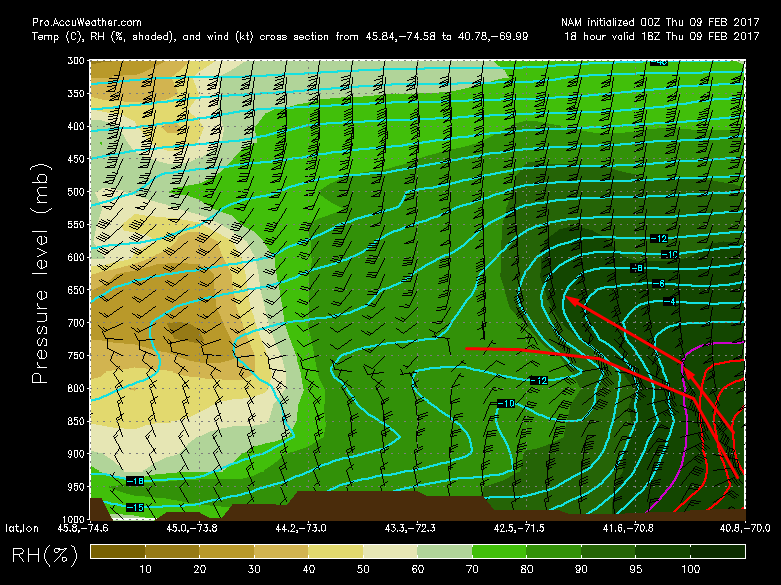
Cross Section Across Coastal New England For This Morning Showing An Elevated Warm Front. Image Credit: Accuweather
As the warm front sharpens and develops through the mid levels, air parcels rushing in from the east/south east hit a wall of cold air. The sharper and steeper that wall is (e.g. the stronger the frontal zone), the faster they have to rise as they are bound to their potential temperature surface. Potential temperature is the temperature that an air parcel (basketball sized chunk of air) would reach if it was dropped to 1000mb (air warms as it drops). There are “surfaces” of potential temperature in the atmosphere and air parcels are bound to that surface in that they rise or fall based on the level of that surface in the atmosphere. In frontal zones, the slope of these surfaces become very steep forcing air parcels to rise steeply resulting in intense upward motion.
This whole process is aided by the explosive development of the surface low off the Mid Atlantic coast and by the fact that the explosively rising air can be vented quickly away by upper level divergence. With winds blowing away from each other in the upper levels, a void is left forcing air from below to rise to fill the area of lower pressure. This helps continue the explosive upward motion. The divergence is enhanced by jet streak coupling where the left exit region of one jet streak overlaps the right entrance region of another. Now that we’ve discussed all the things that go into creating heavy snow bands, why are some missing out?
If you look at the radar image at the top of the post you’ll notice that for every powerful snow band, there’s an equally powerful lull. What goes up must come down which results in sinking motion that suppresses snow. That’s why some folks get nailed with the crushing snow bands and others escape with only moderate accumulations.
These bands are notoriously hard to predict and can make the difference between 6″ and 12″ for any one place. That’s why we give you the ranges in snowfall forecasts- you could end up under a heavy band and get the upper end of the range or it could go the other way. Be prepared for both!
Today will feature cloudy skies, cold temps, and, depending on location, heavy snow. For all the details on specifics/dynamics etc. check out Tuesday evening’s update and for a more general forecast overview, look at last night’s post. Here’s the barebones snapshot. Snow will move in this morning from SW to NE in time for the tail end of the AM commute (if you’re unfortunate enough to have to go to work, go early. you’ll want to leave early too). Snow will become heavy in the afternoon hours with rates of 1-3″/hr at times. Winds will be increasing during the day out of the north so expect blowing and drifting to further reduce visibilities this afternoon. Blizzard conditions are expected along the coast though their duration will be too short for official criteria (need 3hrs+ of 35mph winds and 1/4mi visibility). Snow tapers to snow showers this evening before everyone is dry tonight. Temps will be falling through the 10’s into the single digits.
Today’s update will focus solely on the storm tomorrow. The current thinking is that I’ll have time tomorrow evening to analyze our next few storm threats. With that in mind, let’s dig into what is an interesting and dynamic system for the day tomorrow. We will be right on the edge of a rapidly intensifying coastal storm as it moves from the waters off the mid atlantic past Cape Cod and on towards Nova Scotia. There will likely be a sharp gradient associated with snowfall amounts meaning that any shift east or west will have major ramifications for the forecast.
Since I’m short on time, I’ll quickly go through each of the three scenarios: high end snowfall, low end snowfall, and the current forecast.
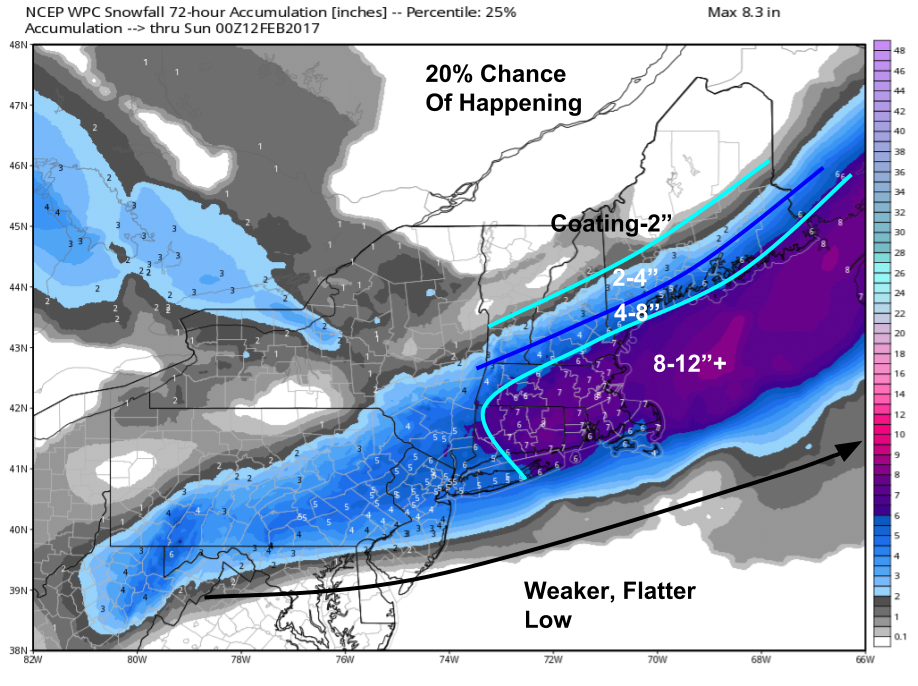
The first scenario is that the storm doesn’t quite develop in time or the upper level trough can’t pull it back as far west as forecast. This would result in less snow. I doubt this will happen due to the orientation of the upper level trough (very negative with SE winds to feed in moisture) as well as the current observations of the storm which are in line with the stronger/farther west guidance so far. However, what goes up must come down and it’s possible that part of the area will get stuck in a subsistence zone as powerful snow bands blast SNE. This would also result in these lighter snow totals. Notice though that even with the lighter outcome, Portland is still likely in for a 6″ snow event.
WPC Probabilistic Guidance Showing The Most Likely Scenario. Image Credit: Weatherbell
Here’s what the WPS thinks is most likely and my thinking (shown in my official snow map below) is fairly close to this idea. The storm will deepen rapidly off the Mid Atlantic coast and move NE towards Nova Scotia. This would result in a fairly substantial snowfall event along the coast with some spots likely seeing up to a foot. The mountains would see lighter amounts with only around 2″ up by the Canadian border.
Here’s a look at what could happen if things develop a little more quickly. Much of the area would see a serious snow event with much of the coast coming in at right about a foot. Right now this does not look likely but given the steady NW trend in guidance, it remains on the table as a possibility. Dendritic growth parameters give us the green light for fluffy snow that will accumulate quite quickly as the day goes on tomorrow so even with low liquid equivalent, ratios will be the friend of those rooting for heftier snowfall totals.
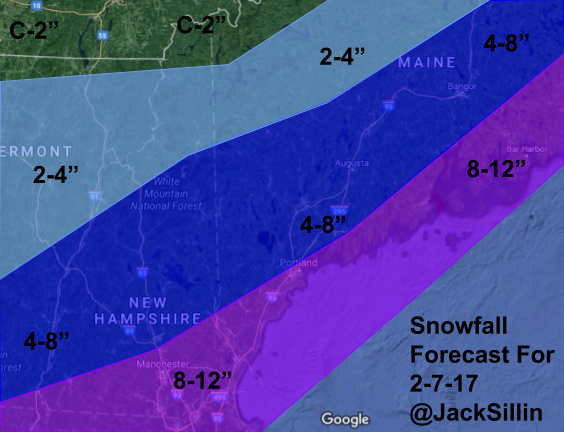
My Forecast
Here’s my forecast for snowfall tomorrow. Guidance is hinting at a band of heavy snow developing over the coastal plain tomorrow afternoon and before that a band of heavier snow over the mountains during the morning hours resulting in the 4-8″ forecast up there. There may be a lull of lighter totals just away from the coast where subsistence between these two bands results in sinking air and lighter snow.
More tomorrow morning on this storm (we’ll know by then which scenario we’re heading for) and tomorrow evening on all the other storms headed our way in the next 7-10 days (there are a bunch!)
Today will feature three distinct periods. The first of winterlike cold and freezing rain is ongoing right now with temps in the 10’s for most, even along the coast. Precip is on its way out and an approaching cold front will result in this period ending mid morning. The turbulence with the cold front will mix down very warm air just over our heads which will result in a second, very mild spring like period today. It will last from mid morning to mid afternoon and feature temps in the 40’s to near 50 along with a few sunny breaks here and there. After the cold front passes through, the third phase begins with gusty NW winds and temps dropping back below the freezing mark tonight.
More snow is on the way tomorrow, read all about that threat in last night’s update.
Today’s snowfall is kicking off an active pattern for at least the next 10 days. Snow will change to a messy mix tonight before moving out tomorrow morning. Temps will fall from near 50 Wednesday afternoon to right around 20 by Thursday morning as snow moves in associated with our next system. After some wind blown fluff Thursday, we’ll get a day off Friday before a clipper system approaches Saturday. Sunday morning will be the calm part of the weekend before more snow/mix arrives with a system Sunday night into Monday morning. Another system may be showing up on the horizon for the middle/latter part of next week but it’s too far out to say what any potential impacts from that may be.
This current system has been slightly misbehaved, the first round having arrived and departed early while the second round dragged its feet in getting here. There wasn’t a lot of data that supported a break in the action today but it happened going to show you that despite our best efforts as forecasters, mother nature is the one really in charge.
HRRR Model Showing Snow Intensifying And Changing To Sleet/Freezing Rain Tonight Into Tomorrow Morning. Credit: Weathebell
The rest of this storm does look to be fairly straightforward with the only major challenge yet to figure out being the timing of the freezing rain -> rain transition. Based on the above model simulation, it appears as though that may not occur until after most if not all the precip has left though other guidance suggests the coastal plain may warm up before then. Either way, a period of ice is likely to make the morning commute slick but temps in the 50’s will make sure any icy spots melt away for the PM commute. After that, temps take a nosedive after dark and end up back in the teens for Thursday morning. That’s when the next round of fun starts.
12Z GFS Showing A Near Perfect Setup For A Large Coastal Storm Thursday. Image Credit: Accuweather
Everything starts at 500mb when it comes to coastal storms and all signals are pointing to a fairly impactful event. The all important trough orientation is forecast to be negative meaning the slope of the trough axis is negative. This allows for the energy that forms the storm to pull out ahead of the main trough where S/SE winds can push it right up the coast. The 500mb pattern is extremely conducive to a more westerly storm track which is why I’ve gone towards the upper range of guidance for snow totals (see map below).
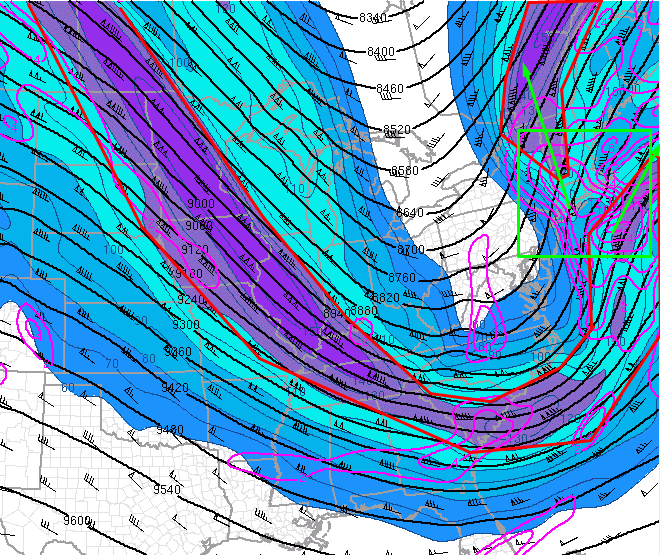
12Z GFS Showing A Jet Stream Pattern Favorable For Rapid Intensification. Image Credit: Accuweather
The jet stream will be oriented in such a way that rapid intensification of the low is supported. While not textbook, there will be two jet streaks coupling to create enhanced divergence in the upper levels as we go through the morning Thursday. Notice the overlap between the right entrance region of the poleward jet and the left exit region of the equatorward jet. This is the area in which divergence is maximized. It lines right up with the coast of New England which is another factor that would support a low track closer to the coast.
12Z GFS Showing Lots Of Upward Motion In The Area Thursday Afternoon. Image Credit: Accuweather
Looking towards the mid levels, the exact placement of strong upward motion will determine who gets the heaviest banding. The jackpot is currently forecast to reside over MA and SNE leaving us with moderately heavy snowfall as opposed to very heavy snowfall. However, a tick NW in the storm track as supported by the 500mb maps would mean those heavier bands would move in our direction. There’s a fine line to walk here and I suspect we’ll have more confidence by the time tomorrow rolls around.
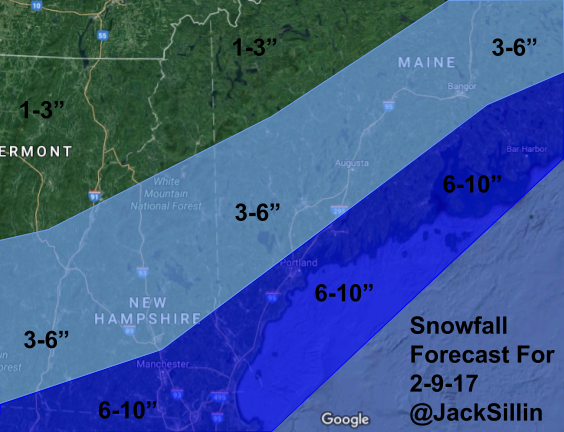
Forecast Snowfall For Thursday
Here’s my thinking for total snowfall Thursday. There’s room for these numbers to go up depending on the exact track. I also think this storm will follow the typical pattern of sharp gradients on the NW edge so a downward adjustment is possible across the mountains. I’ll finalize these numbers tomorrow.
12Z GFS Showing Our Next System Saturday. Image Credit: Weatherbell
Snow will move out Thursday evening leaving a cold and breezy but dry Friday. By Saturday though a clipper system will approach from the west bringing with it more snow. This system looks colder than the one today and lighter than the one forecast for Thursday. A general 1-3″ looks to be a solid early guesstimate on accumulations as guidance is fairly locked in at this point. A little coastal enhancement could develop Saturday night which may result in some moderate snow but otherwise this looks like a fairly benign system.
12Z GFS Showing Another Storm For Sunday Night Into Monday. Image Credit: Weatherbell
The clipper will move out Sunday morning leaving about 12-18 hours of calm before our next storm arrives Sunday night. This one will track right over us, approaching from the west then redeveloping offshore. The exact timing/details have yet to be determined but we have cold high pressure in place and a sharp frontal zone to our south so this one looks fairly likely to cause some trouble as we begin the next week. We’ll discuss amounts as we get closer.
The next storm in our parade is scheduled for the second half of next week but is way too far out to discuss potential timing/impacts/amounts. We’ll keep an eye on it as we get closer!
Beyond that, all indications are that we stay in an active pattern for at least the next couple weeks. Welcome to winter’s comeback!












 Forecasterjack